
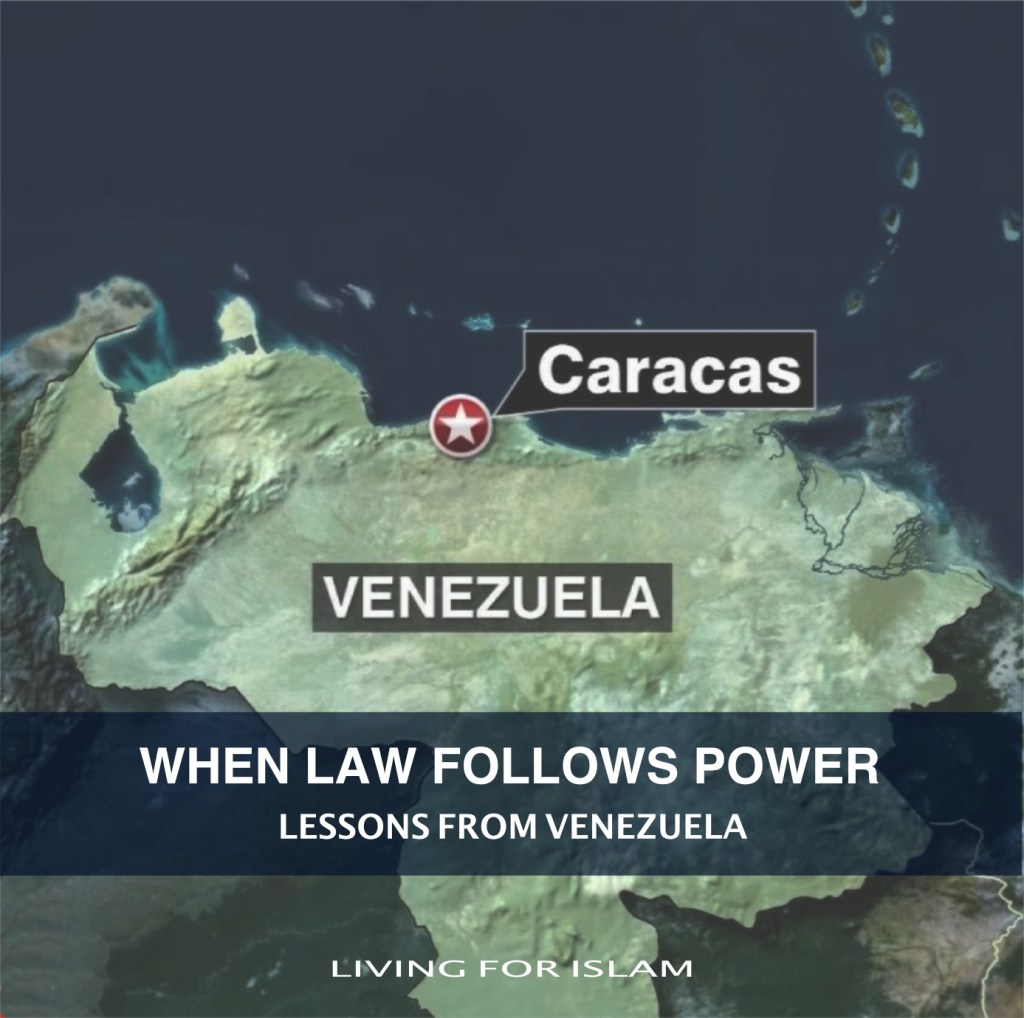
YESTERDAY’S US MILITARY operation in Venezuela, culminating in the removal of President Nicolás Maduro to face charges in New York, has exposed a long-standing contradiction at the heart of Western international law. The United States and its allies frequently invoke a so-called “rules-based international order” to discipline weaker states. Yet their own conduct repeatedly violates the very principles they claim to defend. Military intervention, unilateral enforcement, and extraterritorial jurisdiction point to a system in which law follows power, rather than restraining it.
Venezuela is not an anomaly. It is one episode in a broader historical pattern, one that the Muslim world knows well, where legal rhetoric conceals strategic and economic interests.
Western International Law: Power Above Justice
Modern international law presents itself as universal and impartial. In practice, however, it is decisively shaped by power. The Venezuelan operation, carried out without United Nations authorisation, violated foundational principles of sovereignty and non-intervention. Yet similar violations by Western powers rarely lead to accountability. Instead, the rules are enforced rigorously against weaker states, while powerful actors enjoy de facto immunity.
This imbalance exposes a structural flaw. International law functions less as a constraint on power and more as a language through which power legitimises itself. Venezuela simply makes this contradiction impossible to ignore.
Strategic Interests Behind Moral Rhetoric
Comments by President Trump highlight a key reality. When discussing Venezuela, he stated that U.S. oil companies would help improve the country’s infrastructure and start earning profits from its resources. Regardless of any moral reasons given, such statements show where the true priorities are. Venezuela has some of the largest oil reserves in the world, and when military action and regime change are accompanied by promises of corporate profits, claims of principle become insincere.
The pattern is clear. After Iraq was invaded in 2003, foreign companies restructured its oil sector. Libya’s turmoil in 2011 allowed its energy assets to open up after years of resisting Western control. In both situations, international law was used selectively, and intervention led to material gain. Law didn’t limit power; it facilitated plunder.
Islam’s Justice-Based Constraints on Power
Islamic political thought begins from a fundamentally different premise. Authority is a trust (amānah), and power is subordinate to justice (ʿadl). The Qur’an commands:
وَلَا يَجْرِمَنَّكُمْ شَنَـَٔانُ قَوْمٍ عَلَىٰٓ أَلَّا تَعْدِلُوا۟ ۚ ٱعْدِلُوا۟ هُوَ أَقْرَبُ لِلتَّقْوَىٰ
Indeed, Allah commands you to render trusts to whom they are due, and when you judge between people, to judge with justice. (al-Nisāʾ 58)
Justice applies universally, to allies and adversaries alike, and imposes ethical limits on war, diplomacy, and treaties. Unlike Western practice, Islamic law does not allow the strong to rewrite rules in their own favour.
Authority as a Requirement for Justice
Crucially, Islam does not imagine justice without authority. The Qur’an explicitly links the two:
Justice requires institutions capable of enforcement. Ibn Taymiyyah stated this clearly in al-Siyāsah al-Sharʿiyyah: “It should be known that the exercise of authority (for the benefit) of the people is (one) of the greatest religious duties. Neither deen nor world order may be established without it.”
Historically, the Khilafah played an important role as a legal and political authority that enforced treaties, deterred aggression, and limited abuses of power. Its absence now creates a vacuum, which has been taken over by unilateral Western dominance.
The Muslim World Under Selective Law
Since the dissolution of the Khilafah, Muslim lands have borne the cost of this imbalance. Borders imposed through Sykes–Picot with Western-backed rulers imposed upon the people. Military interventions in Iraq, Afghanistan, and Libya. Ongoing impunity in Palestine despite countless international resolutions
This is not evidence of Islam’s failure, but of its systematic displacement due to Western military, economic and political interference in our lands.
Beyond Condemnation: Responsibility, Not Protest
Exposing Western hypocrisy is necessary, but it is not sufficient. Islam does not offer a politics of complaint. It offers a politics of responsibility. To denounce injustice without working to restore just authority is to accept permanent subordination.
The Muslim world cannot merely critique a system that plunders others under legal pretexts. It must work, deliberately and on principle, to restore righteous authority capable of enforcing justice. This project is not for Muslim benefit alone. Islam’s conception of justice is universal: it restrains domination, protects the weak, and stabilises relations between peoples.
Conclusion: Restoring Balance
The Venezuelan episode confirms what history has shown repeatedly: when power goes unchecked, law becomes an instrument of exploitation. The Western international order, for all its rhetoric, has proven unable, or unwilling, to restrain itself.
Islam offers a corrective. Justice requires authority, and authority must be bound by law. The restoration of a righteous Islamic authority is neither nostalgia nor a threat to global order. It is a necessary counterbalance to one-sided dominance and selective legality.
In a world where principles are invoked to justify plunder, Islam’s justice-based system offers something increasingly rare: law that restrains power, rather than serving it.
 Living For Islam