
MANY MUSLIMS LIVING in the West experience a quiet but persistent unease. Perhaps you have felt it yourself: a sense that something is fundamentally misaligned in how we are forced to relate to money, property, and economic life. Islam offers guidance for all aspects of life, including wealth and resources, yet the systems we depend on often feel morally and spiritually alien.
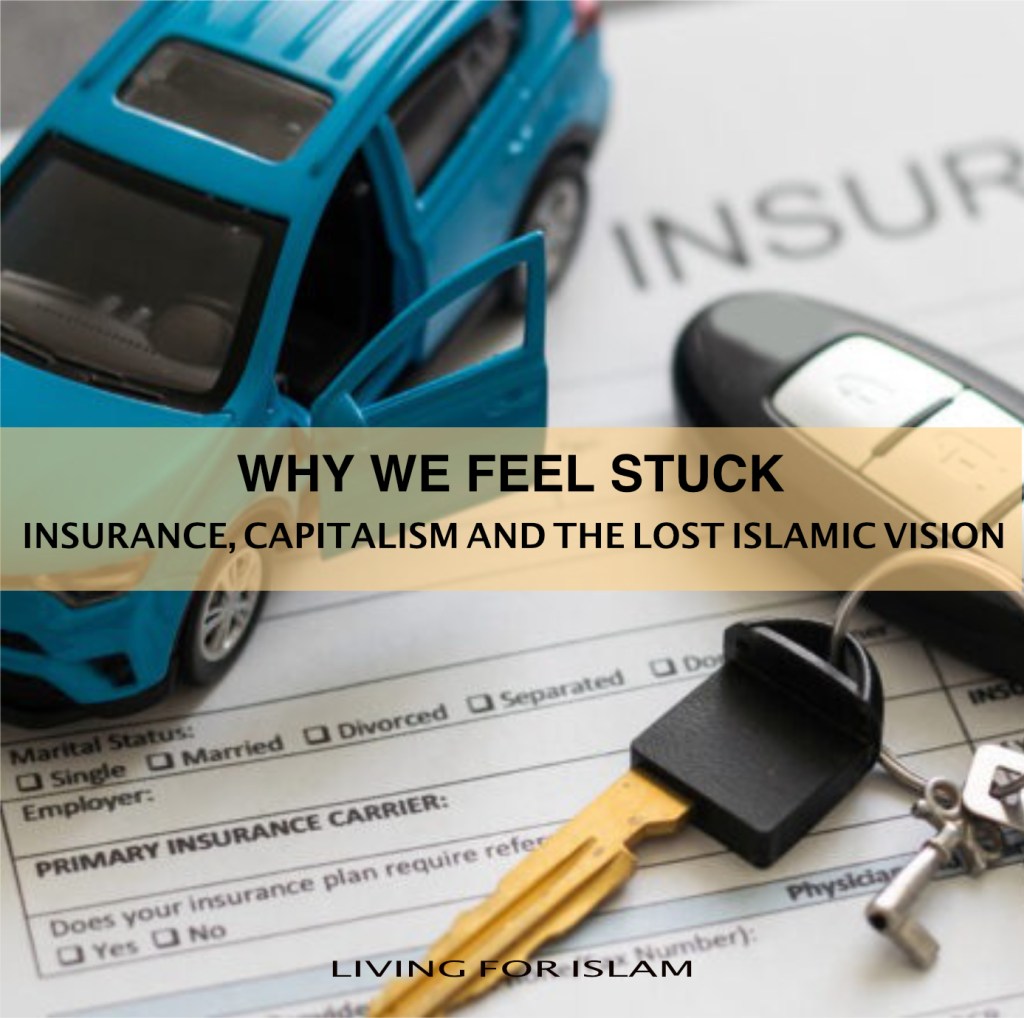
Car insurance, mortgages, pensions, credit, rent, and debt are not optional; they are requirements imposed by law, society, and the economy.
To manage this tension, an entire industry of “Islamic” financial products has developed. Despite decades of effort, however, Muslims continue to debate, hesitate, and feel unsettled. The discomfort has not gone away.
The problem is not simply the absence of Islamic products. The deeper issue is that these products attempt to fit Islamic legal forms into an economic system whose underlying logic conflicts with Islamic moral aims. It is a square peg in a round hole. Functional, perhaps, but never fully at ease. In adapting to capitalism, we risk losing sight of the fact that Islam offers not merely ethical constraints, but a fundamentally different vision of economic life.
Why Britain Insists on Insurance
Consider car insurance in Britain. It is legally mandatory, not merely as a matter of safety, but because it reflects a particular way of organising responsibility and risk. Harm is addressed primarily through markets. Risk is priced, pooled, and sold. Compensation is mediated through private contracts rather than direct moral or communal obligation.
In this framework, the state does not guarantee care for those harmed, nor does it rely primarily on families or communities to repair loss. Instead, participation in a private insurance market becomes compulsory. Victims are protected to an extent, but insurers are also structurally protected, and profit is built into the system. Risk becomes a commodity, responsibility becomes a premium, and justice is increasingly measured in financial terms.
The Qur’an warns against policies and structures that concentrate wealth amongst the rich:
كَىْ لَا يَكُونَ دُولَةًۢ بَيْنَ ٱلْأَغْنِيَآءِ مِنكُمْ
So that it does not circulate solely among the rich among you (Hashr 7).
Yet capitalist systems seem to do exactly that and very well. And living within such systems for long enough can make these arrangements appear natural or inevitable. Yet they represent one particular moral order, not a neutral or universal one, and one that sits uneasily with Islamic values.
Islam’s Different Vision
Islam begins from a different premise. Risk is not primarily a product to be sold, and harm is not a legitimate source of profit. Responsibility is moral before it is financial.
Classical jurists did not object to planning, cooperation, or protection against harm. Their objection to commercial insurance was rooted in deeper concerns: profiting from uncertainty (gharar), gambling-like gain and loss (maisir), and interest-based extraction (riba). These were understood not as technical flaws, but as injustices that distort social relationships.
The Qur’an states clearly:
يَـٰٓأَيُّهَا ٱلَّذِينَ ءَامَنُوا۟ لَا تَأْكُلُوٓا۟ أَمْوَٰلَكُم بَيْنَكُم بِٱلْبَـٰطِلِ
O you who believe, do not consume one another’s wealth unjustly. (an Nisa 29)
Rather than selling risk, Islamic law sought to distribute responsibility through layered human relationships. The individual remains accountable for the harm they cause. The Messenger ﷺ said, “There should be neither harm nor reciprocating harm.” (al Baihaqi)
When an individual cannot bear the burden alone, responsibility extends outward: to family through the ʿāqilah system, to the wider community, and ultimately to the public treasury (Bayt al-Māl). The Messenger ﷺ said, “I am closer to the believers than their own selves. Whoever leaves behind debt or dependents, it is upon me” (Abu Dawud).
This did not guarantee a perfect society. Historical practice varied, and Muslim polities often fell short of their ideals. Yet the normative framework mattered. Justice was not meant to collapse simply because markets failed or individuals lacked resources.
A Lived Difference
Under this moral vision, an accident is not first and foremost a question of policy coverage. It is a question of restoring rights and repairing harm. Economic relationships are embedded within relationships of care, accountability, and belonging. The idea of profiting from another’s misfortune is structurally marginal, not normalised.
This is not naïve idealism. It reflects the moral architecture Islamic law sought to establish, even if historical realities often struggled to uphold it consistently.
Why Islamic Economics Requires Political Authority
Islamic economics was never conceived as a purely private or voluntary ethic. The Qur’an links revelation, authority, and justice:
لَقَدْ أَرْسَلْنَا رُسُلَنَا بِٱلْبَيِّنَـٰتِ وَأَنزَلْنَا مَعَهُمُ ٱلْكِتَـٰبَ وَٱلْمِيزَانَ لِيَقُومَ ٱلنَّاسُ بِٱلْقِسْطِ
We sent Our messengers with clear proofs and sent down with them the Book and the Balance, so that people may uphold justice. (al Hadid 25)
Justice, in the Islamic conception, is institutional. It is upheld through courts, enforceable obligations, state-organised zakat collection, market oversight, and a treasury responsible for those who fall through other safety nets.
Without a political authority committed to these aims, Islamic economic principles can only be partially realised. Risk-sharing remains fragile and voluntary. Zakat becomes fragmented and charity-dependent. Compensation relies on goodwill rather than enforceable duty. In such conditions, societies drift toward interest-bearing debt, private insurance, and profit-driven finance, not necessarily because they are superior, but because they operate effectively at scale within existing power structures.
Capitalist states also shape economic life through law and coercive authority. The difference lies in purpose. One system prioritises market efficiency and capital protection; the Islamic framework prioritises justice, accountability, and moral limits on accumulation.
How We Became Stuck, and What We Lost
Most Muslims today live under non-Islamic political orders and cannot opt out of capitalism. Islamic finance, therefore, emerges largely within capitalist constraints rather than as a comprehensive alternative. The focus shifts from building a just system to avoiding clearly prohibited acts.
The Qur’an recognises necessity:
فَمَنِ ٱضْطُرَّ غَيْرَ بَاغٍۢ وَلَا عَادٍۢ فَلَآ إِثْمَ عَلَيْهِ
Whoever is compelled by necessity, without desire or transgression, there is no sin upon him. (al Baqarah 173)
This principle is essential and merciful. Necessity (darurah), however, was intended as temporary, not as a permanent strategy for our civilisation.
Over time, many have come to equate Islamic economics with conventional finance dressed in Islamic legal forms. Some efforts are sincere and constrained by law; others simply reproduce capitalist outcomes while modifying terminology. Debt remains central. Risk remains priced. Wealth continues to concentrate.
The Qur’an draws a moral line:
وَأَحَلَّ ٱللَّهُ ٱلْبَيْعَ وَحَرَّمَ ٱلرِّبَوٰا۟
Allah has permitted trade and forbidden riba. (al Baqarah 275)
This is not merely a technical distinction. Trade connects effort, risk, and real economic activity. Riba enables extraction without shared vulnerability. When outcomes remain unchanged, legal compliance alone cannot resolve the deeper moral unease many feel. We might check the boxes, satisfy the technical requirements, but we remain morally and spiritually exhausted, still anxious about money, still trapped in debt, still feeling that something essential is missing.
Maintaining Vision While Living in Reality
Islam does not offer only minimum thresholds of permissibility; it offers an ideal to strive toward. Just as we do not abandon the meaning of prayer because khushuʿ is difficult, we do not abandon the concept of Islamic governance or economic justice because full implementation is beyond our reach.
For Muslims in the West, clarity is essential. Islam provides a comprehensive socio-political-economic vision. We are not living under it. Participation in capitalism is often a necessity, not an endorsement. Halal-compliant products are compromises, not ideals.
The Qur’an reminds us not to obscure reality:
وَلَا تَلْبِسُوا۟ ٱلْحَقَّ بِٱلْبَـٰطِلِ وَتَكْتُمُوا۟ ٱلْحَقَّ وَأَنتُمْ تَعْلَمُونَ
Do not mix truth with falsehood while knowingly concealing the truth. (al-Baqarah 42)
In practice, this means:
Maintaining the vision: studying Islamic economics as one strand within a holistic moral and institutional Islamic system, not only as contemporary fiqh rulings.
Building what is possible: cooperatives, mutual aid, interest-free lending, and community risk-sharing, even if limited in scale.
Being honest about compromise: Islamic finance allows us to survive, but it often asks us to stop imagining that things could be fundamentally different.
Working collectively toward an Islamic system, in ways that align society more closely with the Islamic worldview of truth and of justice
The essential question should remain alive: are we adapting Islam to capitalism, or striving to embody Islamic principles despite capitalist constraints?
Conclusion
Islam does not ask us to legitimise unjust systems. It asks us to stand for justice even when we lack the power to fully implement it. Feeling ‘stuck’ between systems is not a failure of faith; it reflects living between two competing moral orders.
The Prophet ﷺ and the early Muslims lived for years under Makkan oppression. They did not pretend that society was just, nor did they accept it as permanent. They preserved a vision of something radically different until conditions allowed it to take form.
We are called to an economic order where wealth circulates rather than concentrates, where risk is shared rather than sold, where debt is exceptional rather than normal, and where justice is upheld institutionally rather than outsourced to markets.
Holding that vision is not a burden. It is a source of moral clarity and hope, especially when full realisation remains beyond reach.
 Living For Islam