
THE SITUATION IN Palestine and other conflict areas in the Muslim world is a moral test for Muslims. Not because the truth is unclear, but because acting upon it carries a cost.
Most Muslims care deeply. Many feel grief, anger, and helplessness. Yet day after day, small opportunities to act quietly pass us by. A conversation not started at work. A false claim left unchallenged. A protest not attended. A donation delayed. Silence chosen because it feels safer.
These moments are rarely dramatic. They are ordinary, almost invisible decisions. And they expose something uncomfortable: much of our hesitation is not due to ignorance, but fear.
Fear, Silence, and Accountability
Islam does not deny fear. Fear of social backlash, professional consequences, or reputational harm is real. But Islam does not allow fear to become an excuse for abandoning truth and justice.
Allah ﷻ addresses this directly:
فَلَا تَخَافُوهُمْ وَخَافُونِ إِن كُنتُم مُّؤْمِنِينَ
“So do not fear them; fear Me, if you are truly believers.” (ale Imran 175)
This verse does not suggest that fear disappears. It reframes it. The question is not whether we fear consequences, but which fear ultimately governs our choices.
Silence, too, is a choice. Comfort is not morally neutral. When injustice is clear, inaction becomes a decision for which we are accountable, even if that decision feels polite, cautious, or socially acceptable.
Allah ﷻ reminds us of this tension and accountability:
أَحَسِبَ ٱلنَّاسُ أَن يُتْرَكُوٓا۟ أَن يَقُولُوٓا۟ ءَامَنَّا وَهُمْ لَا يُفْتَنُونَ
Do people think they will be left to say, ‘We believe,’ and they will not be tested? (al-Ankabut 2)
Iman, when untested, remains a claim. It is pressure that reveals its substance.
What Is Required of Us
Islam does not demand recklessness or heroics. It does not require every Muslim to take the same actions or face the same risks. What it demands is principled effort, grounded in sincerity and trust in Allah ﷻ.
Speaking the truth may cost approval. Public advocacy may invite criticism. Aligning oneself with justice may affect opportunities. These outcomes are not signs of misguidance. They are often the expected cost of obedience.
The Messenger of Allah ﷺ said: “Whoever seeks the world will be harmed in the Hereafter, and whoever seeks the Hereafter will be harmed in the world. So be harmed by the ephemeral for the sake of the everlasting.” (al-Zuhd, Ibn Abī ‘Āṣim)
This hadith is not comforting; it is clarifying. Seeking the akhirah will cost something in the dunya. Loss is not evidence of failure. In many cases, it is evidence of sincerity.
Reframing Risk in Islamic Terms
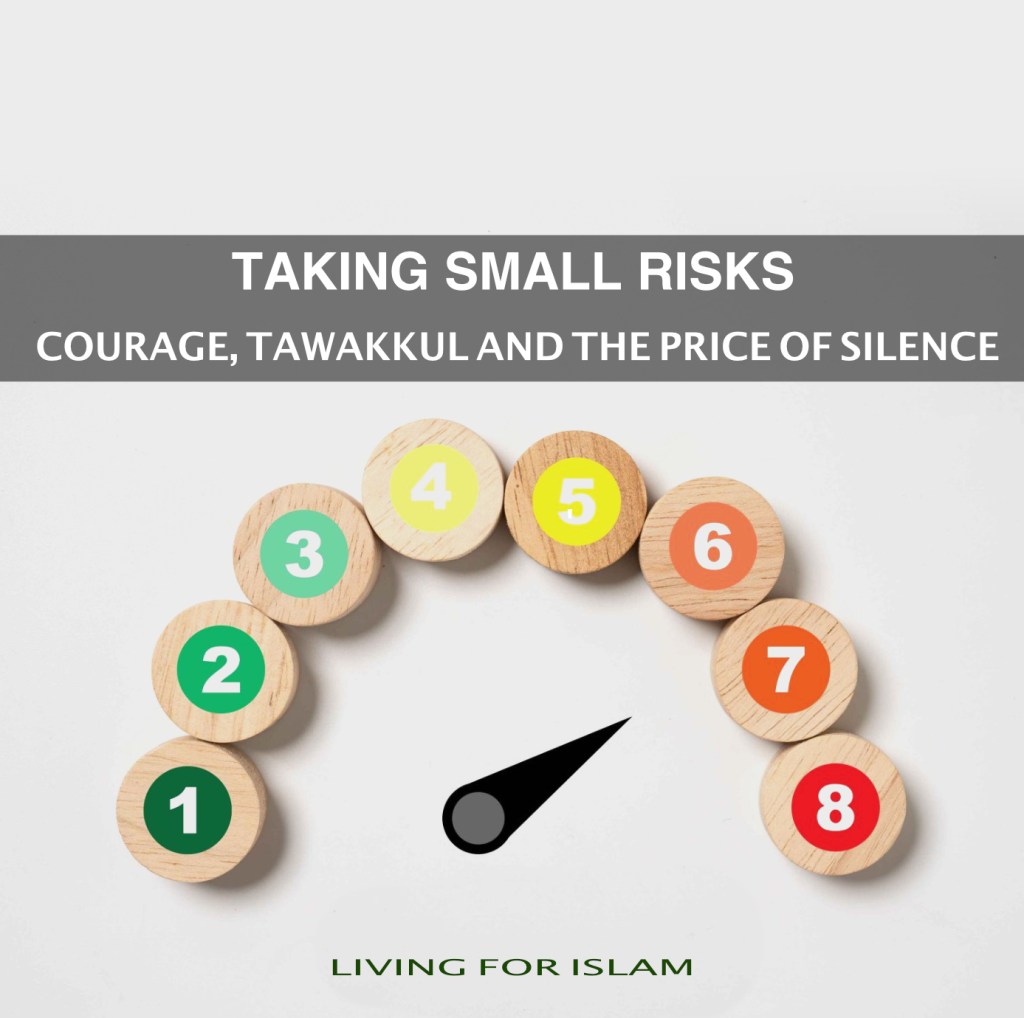
Much of our paralysis comes from misunderstanding risk itself.
Islam does not praise impulsiveness or thoughtless action. Recklessness is blameworthy. But Islam equally rejects cowardice disguised as caution. (Moral) courage is acting upon what is right with wisdom, even when the outcome is uncertain.
This is where tawakkul begins. Tawakkul is not passivity or wishful thinking. It is acting once responsibility is clear, then entrusting the outcome to Allah ﷻ.
Allah ﷻ promises:
وَمَن يَتَوَكَّلْ عَلَى ٱللَّهِ فَهُوَ حَسْبُهُۥٓ
And whoever relies upon Allah, then He is sufficient for him.” (at Talaq 3)
But reliance does not replace effort. The Qur’an also commands preparation and action. Together, these teachings show that obedience comes first; outcomes belong to Allah.
Risk, in this sense, is not thrill-seeking. It is obedience when obedience has a price.
Small Risks as Training
Most of the risks that shape us are not dramatic. They are small, repeated, and often unnoticed.
They include:
* Ethical financial choices made without guaranteed benefit
* Social risks, such as speaking to someone unfamiliar or isolated
* Intellectual risks, such as learning or expressing an unpopular view
* Emotional risks, like honesty when silence feels safer
* Moral risks, when standing for truth threatens comfort or acceptance
These moments train the nafs. They loosen our attachment to certainty and strengthen our willingness to act before reassurance arrives.
Small actions are not small in the sight of Allah ﷻ when they are sincere and consistent and there effects over time are cumulative.
Conclusion
Islam does not judge us by outcomes. It judges us by intention, effort, and sincerity. Allah ﷻ can magnify the smallest deed, join scattered actions, and open doors we could never plan for. But He does not act on our behalf when we refuse to act at all.
The decision to take that first step, to accept a measured, principled risk in pursuit and support of truth and justice, is ours.
If we want to grow in taqwa and character, we must normalise this kind of courage. We must resist the idea that safety equals righteousness and that comfort equals wisdom.
Because silence, too, is a choice.
And one day, it will not be our comfort that is questioned, but our deeds.
And Allah ﷻ knows best.
 Living For Islam