
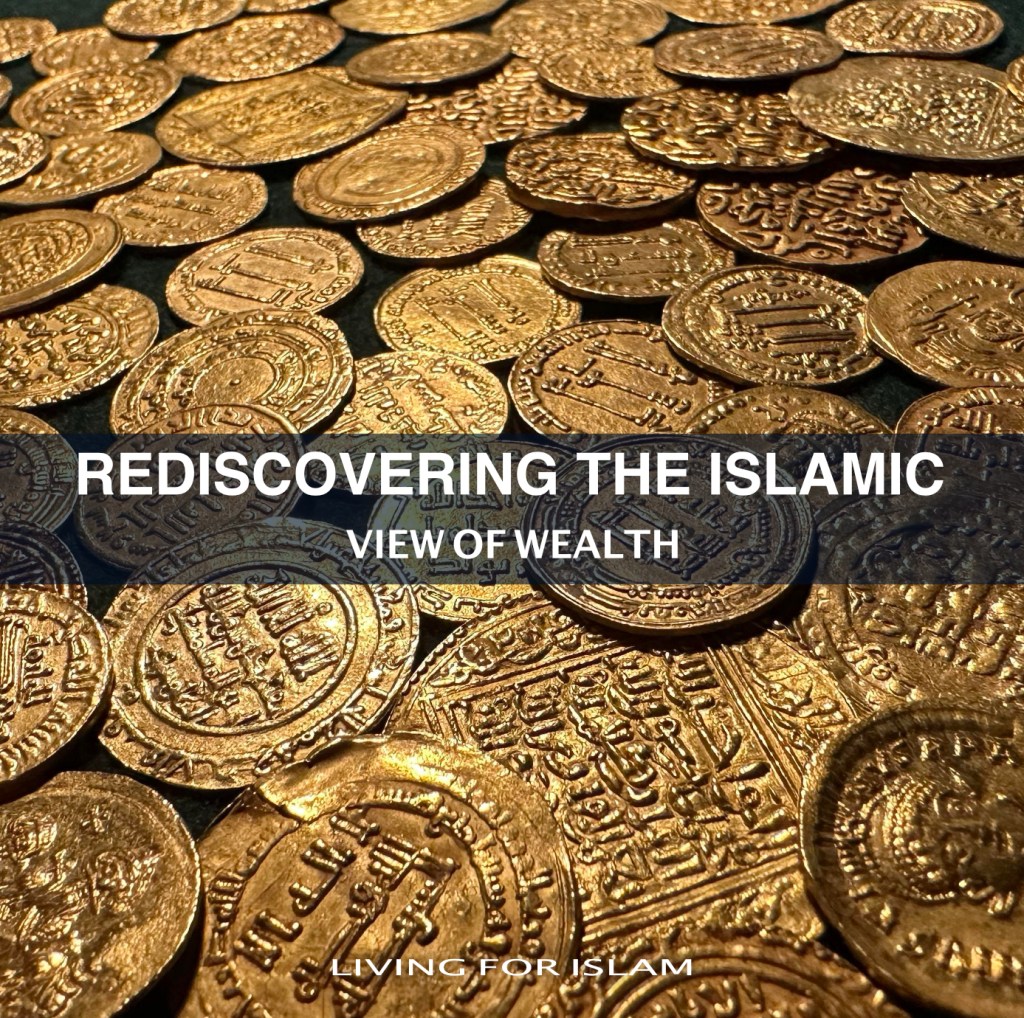
‘EVERY NATION HAS a trial, and the trial of my nation is wealth,’ said the Prophet ﷺ (Tirmidhi).
He ﷺ also said: ‘By Allah, I do not fear poverty for you. Rather, I fear that worldly riches will be given to you as they were to those before you. You will compete for them as they competed, and they will destroy you as they destroyed them.’ (Bukhārī)
We need to keep returning to the issue of wealth because of how deeply today’s materialistic way of life shapes our thinking. It builds a worldview detached from Divine guidance, one that reduces spiritual, moral, and humanitarian values to secondary concerns, while making material gain the main purpose of life.
This worldview promotes individualism and the idea that wealth belongs to you absolutely and is earned solely through your own effort. It makes us believe that resources are scarce and there isn’t enough to go around. Life becomes “every man for himself.” It makes us unsatisfied with what we have. It pushes envy of those who have more and contempt of those whose who have less. And if they were to receive anything we question why them and not us and whether they truly deserve it.
We are pushed to become constant consumers. Advertising surrounds us everywhere, urging us to pursue pleasure and possessions. Success is measured by what we own, until wealth becomes an end in itself rather than a means to higher goals.
Why has this way of life become so dominant? Because it appeals to the lowest part of human nature. It encourages it, feeds it, and strengthens it.
أَلْهَىٰكُمُ ٱلتَّكَاثُرُ ۞ حَتَّىٰ زُرْتُمُ ٱلْمَقَابِرَ
“Competition for more distracts you, until you reach your graves.” (At-Takāthur 1–2)
The Prophet ﷺ said: “If the son of Adam had a valley full of gold, he would want two.” (Bukhārī)
But when this desire is left unchecked, it becomes destructive. We are all now experiencing the consequences.
- As individuals, are we truly happier just because we have more things?
- As a society, life feels increasingly harsh. The poor are dismissed as burdens, the elderly as no longer useful, and the gap between the rich and the poor keeps growing.
- As a world, we face waste, pollution, and environmental harm on an unprecedented scale.
Living in this environment affects us unless we actively counter these ideas.
The Prophet ﷺ said: “Two hungry wolves set loose among a flock of sheep are less harmful than a man’s desire for wealth and fame is to his faith.” (Tirmidhi)
Islam offers a balanced way of life. It gives material, spiritual, moral, and human values their proper place, none overwhelming the others. This balance helps us seek the best of the Hereafter without neglecting what we need in this world. Like everything in Islam, it begins with ideas, but it reaches its full expression only when supported by a political system (the Khilafah rashidah) that puts these values into practice at a societal level.
While Islam teaches many concepts about wealth, they can be summarised in four key principles. If we internalise these, within ourselves, our families and as an ummah, they can help us navigate this test.
- Wealth belongs only to Allah
- Wealth, like poverty, is a test
- Allah gives to Whom He wills with perfect wisdom
- Gratitude is an essential attitude
I hope to explore these ideas further, and, if Allah wills, conclude with the story of Qarun, a Qur’anic example that ties them all together.
 Living For Islam