
ONE OF THE GREATEST tragedies of our time is that many who claim to speak for Islam fail to speak clearly.
When asked simple, direct questions about the religion, they often respond with slogans, buzzwords, or vague political phrases. Instead of guiding the people, they obscure the truth. Why? Fear. Fear of losing votes, fear of offending Western ideas, fear of appearing “radical.”
The result is confusion, not clarity. Misrepresentation, not guidance. Misleading the faithful in the name of Islam is a far graver crime than plain truth-telling.
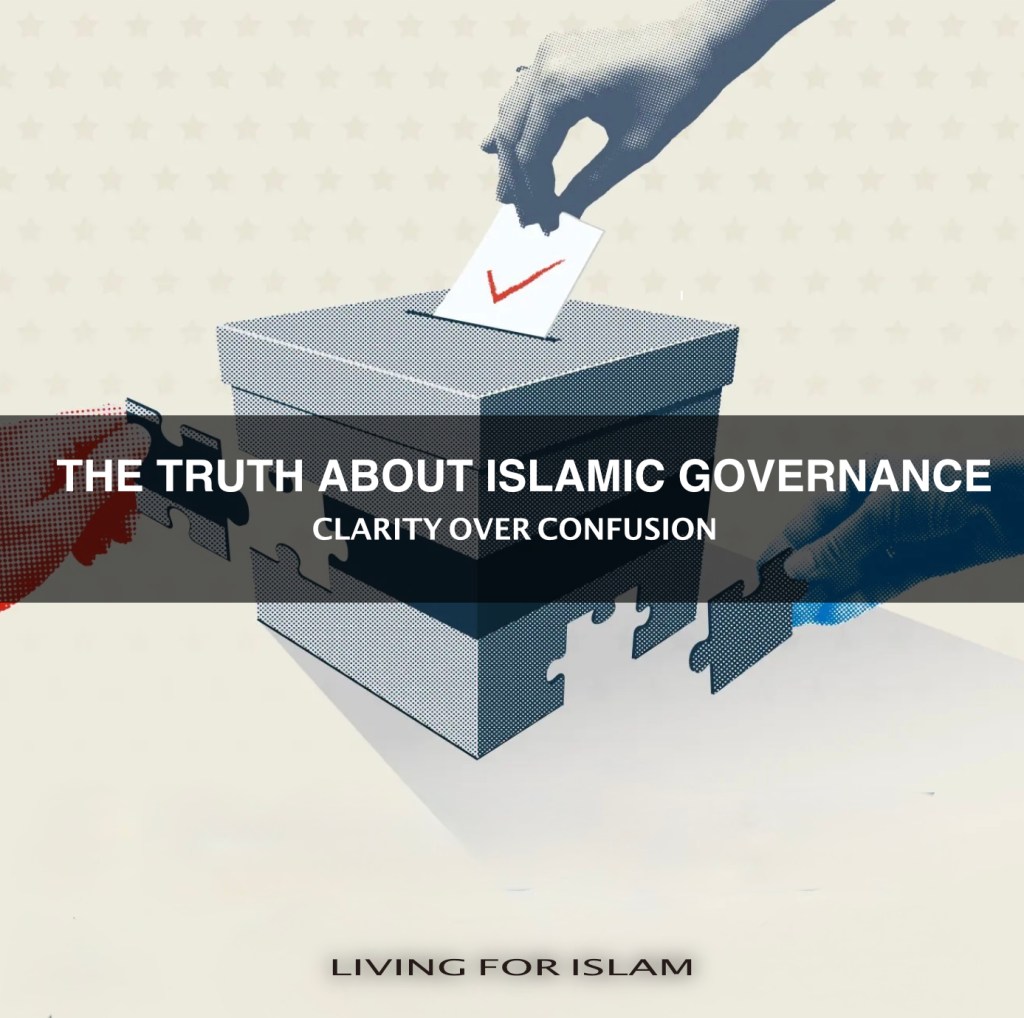
Consider a straightforward question: “Is democracy compatible with the Islamic khilafah model of governance?”
I have heard the answer: “We will establish a modern democratic khilafah!”
This is not an answer, it is a contradiction. Words like “Islamic republic,” “halal interest,” and “democratic khilafah” are empty slogans. They sound appealing hybrids, but beneath their surface lies confusion. They mix ideas that cannot coexist, creating nothing but contradiction.
What the People Truly Want
What do the people of the Muslim world actually desire? Not slogans. Not Westernized catchphrases. They want:
- The ability to choose their leaders,
- Representation in governance,
- Mechanisms to hold rulers accountable.
These are basic rights long denied under monarchs, dictators, and “democratic” elites who govern our lands in the interests of themselves and their foreign backers.
The West claims to offer a solution: democracy. Elections every few years, they say, empower the people. Choose your leaders, remove them if disappointed. Problem solved.
But democracy’s core is not merely voting. Democracy grants humans the authority to legislate, to make law. Sovereignty is transferred from Allah to people.
Islam is clear: sovereignty belongs to Allah alone.
Humans may govern, but they may never legislate. The Qur’an is unambiguous:
إِنِ الْحُكْمُ إِلَّا لِلَّهِ
Legislation is only for Allah. (Yusuf 40)
وَأَنِ احْكُم بَيْنَهُم بِمَا أَنزَلَ اللَّهُ وَلَا تَتَّبِعْ أَهْوَاءَهُمْ
Judge between them by what Allah has revealed, and do not follow their inclinations. (al-Ma’idah 49)
Democracy’s claim to legitimacy, human legislation, is a direct challenge to divine sovereignty.
Democracy Does Not Deliver Representation or Accountability
History exposes the myth of democratic representation. Entire populations, slaves, women, and people of colour, were excluded for centuries. Even in Britain, the voting age of 18 was only introduced in 1970. And today, questions remain about whether younger citizens should vote.
As for accountability, Western politicians are among the least trusted people in society. Corruption is routine. Election promises are broken. Elites manipulate systems to their advantage. Voting every few years brings little change to the point many people have stopped voting.
Democracy, in short, does not ensure representation. It does not guarantee accountability. Its failures are evident even in the West.
Islam Provides True Representation, Participation and Accountability
The khilafah model offers what democracy cannot.
The people freely choose their leader through bayʿah, a binding pledge.
Once chosen, the khalifah rules by Islam, not by public opinion.
Voting is a tool that can be adopted to register people’s choice. Historically, at the time of the sahabah, tribal leaders pledged bayʿah on behalf of their communities, ensuring representation.
Islam institutionalises shura (consultation) in areas not fixed by revelation, allowing participation where human judgment is valid.
Critically, the people can hold the ruler accountable at any time. A khalifah who violates his role can be removed by judicial process, not just every few years at the ballot box.
This system combines accountability, representation, and divine law, without compromise.
Democracy Cannot Protect Islam’s Core Principles
Some argue Muslims must use elections to gain power. This reasoning is fatal.
If legitimacy depends on votes, then Islam can devoted in but also can be voted out. Human approval determines divine law. Islam does not allow the deen to be subject to the whims of the majority.
When Quraysh suggested alternating rule between themselves and the Prophet ﷺ, allowing people to choose between Islam and disbelief, Allah revealed Surah al-Kafirun:
لَكُمْ دِينُكُمْ وَلِيَ دِينِ
To you your way, and to me mine.
The message is absolute: the foundations of Islam are non-negotiable. They cannot be compromised for political expediency.
A Warning to Those Who Speak in Islam’s Name
وَلَا تَلْبِسُوا الْحَقَّ بِالْبَاطِلِ وَتَكْتُمُوا الْحَقَّ وَأَنتُمْ تَعْلَمُونَ
Do not mix truth with falsehood or conceal the truth knowingly. (al-Baqarah 42)
Democracy and khilafah are not variations on a spectrum. They are opposites, fundamentally incompatible in philosophy, authority, and outcome.
To mislead, confuse, or water down the truth is far worse than speaking plainly, even if the truth is unpopular. Muslims deserve clarity. Islam demands honesty.
 Living For Islam