

YOU KNOW WHAT’S really sad? After almost 20 years of the government’s Prevent programme, all the money, the speeches, the endless training sessions, even the people running counter-terrorism now admit it’s not working.
An independent commission has finally said it: Prevent isn’t keeping the country safe. And honestly, that’s something Muslims in Britain have been saying for years. The strategy hasn’t just failed to stop terrorism, it’s made life harder for the very people it claims to protect.
The Big Mistake: Confusing Faith with Danger
From day one, Prevent was built on a false idea, that the more religious a Muslim becomes, the more “at risk” they are of turning into an extremist.
That’s the logic behind the so-called “conveyor belt theory.” Start praying more? Suspicious. Grow a beard? Concerning. Talk about injustice in Palestine? Maybe radical.
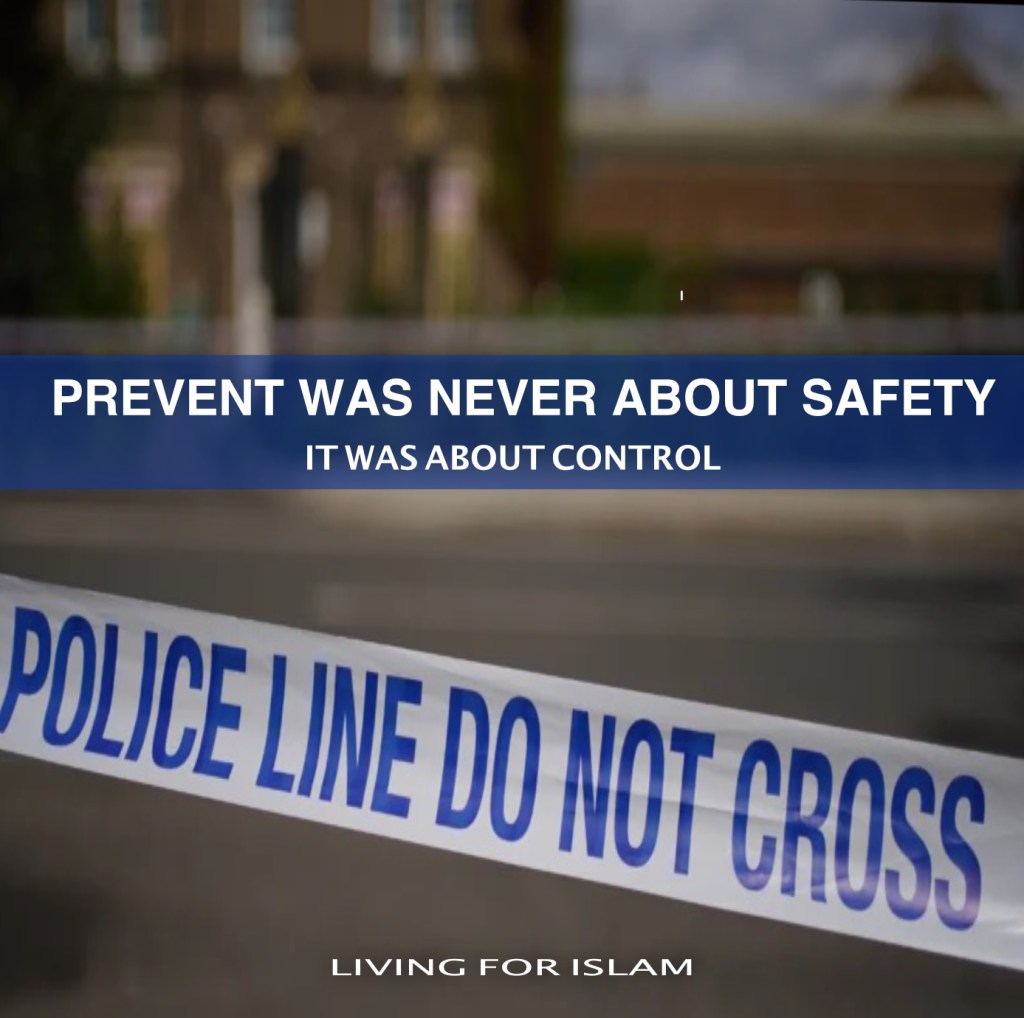
This was never about safety, it was about control. It turned expressions of faith, things completely normal and deeply valued in Muslim life, into red flags.
We’ve seen absurd cases: a four-year-old referred to Prevent for saying “cooker bomb” instead of “cucumber.” Teachers, students, even doctors questioned for quoting the Qur’an or wearing a hijab.
Teachers, social workers, and doctors found themselves in impossible positions under the Prevent duty — turned into spies against the very people they were meant to look after.
How is that supposed to build trust? It’s not protecting anyone, it’s criminalising identity.
The Politics Behind It
Let’s be real, this was never just about terrorism.
As the Muslim world began to reconnect with Islam after a century of secular division and Western-backed tyrants in our lands, especially after 9/11 and the Arab Spring, the British government became anxious about Muslims here reconnecting confidently with their faith and the global ummah.
And what better way to control that sentiment than to demonise an entire community under the guise of “preventing extremism”? By creating suspicion and fear, Prevent made Muslim identity itself something to be watched, not welcomed.
Even within our community, there were those who chose to cosy up to the government, taking funding and legitimacy to push the Prevent narrative, dividing the community, and silencing genuine grassroots voices. Instead of standing with the community, they became part of the machinery that kept it weak and divided.
The Numbers Don’t Lie
Between 2015 and 2023, over 58,000 people were referred to Prevent. More than 90% were cleared with no connection to terrorism.
That’s tens of thousands of people dragged into a counter-terrorism process for nothing.
Imagine being a kid whose teacher suddenly thinks you’re a threat. A parent getting a call saying your child’s been “referred.” A university student having their future thrown off course because of a research paper.
Those experiences don’t fade, they stick. They make entire communities feel watched, unwelcome, and unsafe.
And the worst part? While Prevent chased shadows, real threats sometimes slipped through. It’s failing on both fronts: it’s not stopping attacks, and it’s destroying trust.
The World Has Changed. Prevent Hasn’t.
Terrorism today isn’t what it was twenty years ago. It’s no longer about big, organised networks. Most threats now come from isolated individuals, people struggling with personal issues, trauma, or mental health problems.
But Prevent still acts like we can “spot” radicalisation by looking for religious signs. Even the government’s own experts now admit that belief alone doesn’t predict violence.
That should have been the end of this outdated, paranoid approach. But somehow, it keeps going.
The Real Damage: Losing Trust
Here’s what people don’t get, Prevent doesn’t just waste time. It breaks relationships.
How do you trust your school when your child could be reported for a slip of the tongue? How do you speak freely about world events when you fear being labelled “radical”?
So Muslims become cautious, quieter, self-censoring. We start second-guessing what we say, what we post, what we teach, who we invite to our mosques.
Young people lose safe spaces to talk honestly about what Islam actually says about violence, and our imams and educators are silenced.
When that happens, everyone loses. You can’t build safety on suspicion.
If You Really Want Prevention…
If the government truly wants to keep the country safe, it needs to stop treating Muslims as a problem and start listening to us, not dismissing us.
Real prevention means supporting people who are struggling with loneliness, trauma, or mental health before it spirals.
It means building community trust, not fear.
It means tackling racism, inequality, and hopelessness, the real roots of hate.
And yes, it means being honest that British foreign policy, past and present, plays a role in global instability and injustice.
Because you don’t fix terrorism by policing religion. You fix it by fixing society and injustice.
Unfortunately, the track record of secular societies to do all that is very poor. Without Divine guidance, these states just do not have the tools needed to create a just and holistic framework that gives all citizens their rights.
Let’s Be Honest
Muslims don’t need to apologise for who we are. Our faith teaches truth, mercy, and justice; values this country could actually use more of.
The problem was never Islam. The problem was Prevent, and the way it was used to paint Islam as suspect from the start.
Prevent needs to go, replaced by something fair, evidence-based, and built on respect.
Because right now, the biggest threat to Britain isn’t its Muslim citizens. It’s the fear, ignorance, and division Prevent and the politics of populism have left behind.
And here’s the irony: the authoritarian tools first used against Muslims are now being turned on everyone, with shrinking civil rights and the silencing of dissent. What began with suspicion of one community is now shaping the whole society.
 Living For Islam
One thought on “Prevent Was Never About Safety. It Was About Control”