

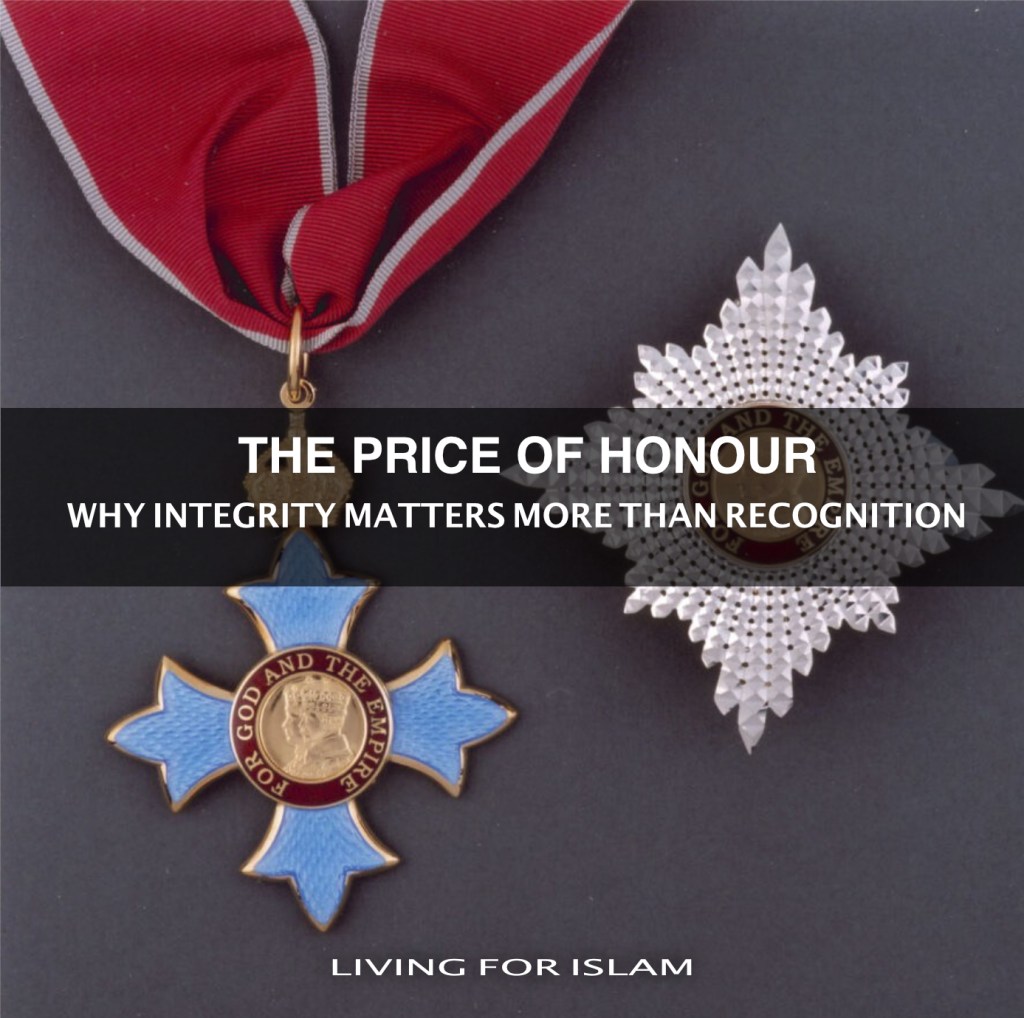
SHOULD MUSLIMS ACCEPT honours like knighthoods from the British Government?
No. Such titles raise profound questions about loyalty, integrity, and the true source of honour.
The majority of Muslims in Britain trace their heritage to the Indian Subcontinent, lands that once endured the weight of British colonial rule. We, of all people, should remember what such honours once meant. Under the British Raj, knighthoods were not badges of virtue; they were instruments of power and control.
What did these honours represent?
- Political loyalty. They were rewards for obedience to colonial authority.
- Divide and rule. Titles were given along religious lines, sowing division between Muslims, Hindus, and others.
- Social hierarchy. A privileged class was created — beneficiaries of the empire, while the rest lived under subjugation.
- Moral disguise. These honours cloaked injustice in a robe of respectability, making tyranny appear fair and civilised.
The purpose was never to celebrate moral excellence. It was to secure loyalty and weaken resistance.
Though the empire’s flag is not present in our lands, its methods often persist. Honours given by powers that stand against Islam are not neutral actions. It affects how we see ourselves and how we are seen by others. When a Muslim accepts such honours, it’s viewed not just as personal achievement but as support for systems that have undermined the dignity of our deen.
True honour, however, is not bestowed by kings or governments. It flows from integrity before Allah.
Imam al-Bukhari understood this truth with clarity and conviction. During his travels, a man falsely accused him of stealing a thousand gold coins. To protect his reputation, Imam al-Bukhari threw his own gold into the sea, choosing the loss of wealth over the loss of trust. He knew that once suspicion touches a name, it rarely departs. For him, dignity before Allah was worth more than any treasure the world could offer.
Reputation is a sacred trust. It is built through honesty and guarded through restraint. Every choice shapes it. Every companionship reflects it. Every action reveals what lives within the heart.
Look at the world around us. A single message can destroy a career. A careless word can undo a lifetime of work. Statues rise and fall, names are celebrated and forgotten, and history rewrites its judgment with every generation. Yet the only legacy that endures is truth, the kind that is remembered in the heavens even when forgotten on earth.
Prophet Ibrahim (as) made this dua:
وَاجْعَل لِّي لِسَانَ صِدْقٍ فِي الْآخِرِينَ
And grant me an honourable mention among later generations. (ash-Shu‘ara 84)
He did not seek applause or prestige; he sought to be remembered with truth, to have a name purified by sincerity, not adorned by worldly praise.
Our Prophet ﷺ taught the same vigilance in protecting one’s reputation. One night, during iʿtikāf, he was walking with his wife Safiyyah (ra) outside the masjid. Two men of the Ansar passed by, and the Prophet ﷺ said to them: “Wait. This is my wife, Safiyyah bint Huyai.” They replied: “Subhan Allah! We would never think evil of you.” The Prophet ﷺ said: “Shaytan flows through the human being as blood flows through the body, and I feared he might cast an evil thought into your hearts.” (Bukhari)
If the Messenger of Allah ﷺ, the best of all creation, guarded himself from even the shadow of suspicion, how much more should we protect our own integrity?
Allah reminds us where true honour lies:
مَن كَانَ يُرِيدُ الْعِزَّةَ فَلِلَّهِ الْعِزَّةُ جَمِيعًا
Whoever desires honour, then to Allah belongs all honour. (Fatir 10)
And He warns against seeking dignity from those who reject faith:
الَّذِينَ يَتَّخِذُونَ الْكَافِرِينَ أَوْلِيَاءَ مِن دُونِ الْمُؤْمِنِينَ أَيَبْتَغُونَ عِندَهُمُ الْعِزَّةَ فَإِنَّ الْعِزَّةَ لِلَّهِ جَمِيعًا
“Those who take disbelievers as allies instead of believers — do they seek honour with them? Indeed, all honour belongs to Allah.” (an-Nisa 139)
As Ibn al-Mubarak wrote in Kitab al-Zuhd wa al-Riqāq: “Do not seek to be known. If you are worthy, Allah will make you known.”
So guard your credibility. Refuse honours that compromise your independence. Value the trust that no title can replace.
Reputation takes a lifetime to build, and only a moment to destroy. The believer’s true honour is not in the praise of people, but in the acceptance of Allah, the only recognition that endures beyond the grave.
 Living For Islam