
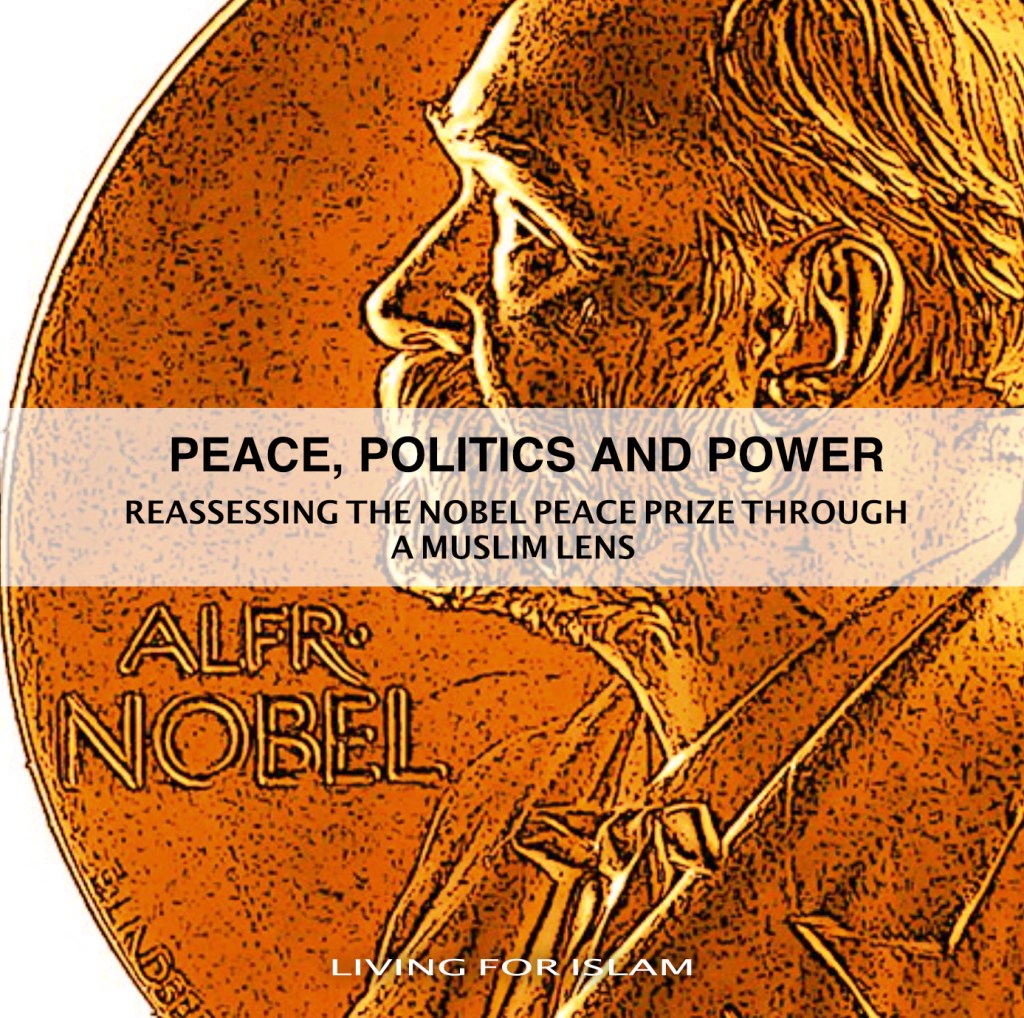
YOU WOULD THINK that peace is a universal concept and that the Nobel Peace Prize is a symbol of this. It is meant to recognise individuals and organisations that have made exceptional efforts to promote peace, resolve conflicts and advance human rights.
But over the years, I began to notice a pattern. The prize seemed to reward a certain kind of peace, conflict resolution and human rights, ie those that align with Western liberal ideology rather than with any truly global understanding. And increasingly, Muslims were recognised only when they fit a particular narrative; one that served dominant political or ideological interests, not necessarily the cause of peace itself.
A Prize Shaped by Politics
The Nobel Peace Prize isn’t awarded by a body representing the world’s diverse people, but by a five-member committee appointed by the Norwegian Parliament, a European, NATO-aligned institution. This matters.
The prize is not just a recognition of moral achievement. It’s a political signal, shaped by the values of those who grant it. And those values, however noble they may appear, are deeply influenced by Western secular liberalism; a worldview that sees itself as superior and stands at odds with others, including Islamic ones.
Who Gets Celebrated — and Why?
If we look at some of the laureates of the last 20 years, we see the way they’re framed is indicative of something deeper.
Barack Obama (2009)
President Obama was awarded the Peace Prize just months into his presidency, long before his policies were tested. His speeches were enough.
Yet his vision of ‘hope’ turned to increased drone strikes across the Muslim world, killing thousands. The same man who escalated military interventions was being honoured as a peacemaker. The message was clear: Listen to our words, ignore our actions, especially when they come from the right side of global power.
Nadia Murad (2018)
Nadia Murad courageously spoke against ISIS’s brutal violence against Yazidis, especially women.
Yet her award also fit a familiar pattern: Muslims were once again cast as perpetrators of extremism, and minorities were framed as victims in need of Western salvation. There was little mention of how Western invasions, particularly the Iraq war that was built on lies, destabilised the region and created the conditions for ISIS to emerge. And while her voice on violence against women in war is rightly amplified, her silence on the abuse of Palestinian women and girls in Israeli prisons speaks volumes about whose suffering is deemed worthy.
Malala Yousafzai (2014)
As a young girl who was shot by the Taliban for going to school, Malala advocated for girls’ education. But again, the framing in her story mattered. Her story was cast as a struggle against the backwardness of Islam, rather than within an Islamic society striving for reform.
The same Western media that celebrated her completely ignored the other girls who were killed or injured by US drones in Pakistan. Malala was embraced not for challenging all forms of violence but for reinforcing Western narratives about Muslim societies. And once again, she has remained silent on girls’ education in Gaza, affected by the genocide.
Muhammad Yunus (2006)
Muhammad Yunus was praised for his microcredit model, offering small loans to the poor, mainly women. Innovative, yes, but it aligned comfortably with neoliberal development frameworks. His model didn’t challenge the capitalist global economic system; it operated within it, even helping to expand and entrench riba in a Muslim majority society. Once again, a Muslim was honoured — not for offering an alternative economic vision, but for adapting to Western models.
Narges Mohammadi (2023)
Mohammadi’s activism in Iran, particularly against compulsory hijab laws, earned her global recognition. But again, the framing was unmistakable: she wasn’t just resisting authoritarianism, but was cast as resisting Islamic governance itself.
This wasn’t a celebration of nuanced dissent — it was the elevation of secular resistance over any faith-based struggle for reform. There was no space for Muslim women who champion rights within Islamic frameworks, or who find faith empowering, not oppressive.
Who Gets Ignored?
Just as revealing is who doesn’t get recognised.
* No Palestinian peacemakers, despite decades of nonviolent resistance. Whilst Yasser Arafat received a third of the Prize wth Israeli leaders Yitzhak Rabin and Shimon Perez in 1994, this seems to be for his role in recognising Israel in the Oslo Accords and putting down arms rather than any move to secure justice and freedom for the Palestinians. 30 years on, we do not see peace but a genocide unfolding. Similarly the 1978 Peace Prize went to Anwar al-Sadat of Egypt and Israel’s Menachem Begin ‘for jointly having negotiated peace between Egypt and Israel’.
* No Iraqis, Afghans, Kashmiris, Rohingya or Yemenis, despite immense suffering and courageous efforts to rebuild.
* No scholars of Islamic law or ethics advocating reconciliation and restorative justice through faith.
Muslims are honoured when we challenge authoritarianism, but not when we challenge imperialism. We’re celebrated when we speak the language of secular liberalism, but ignored when we draw on our own tradition to imagine a more just world.
Islam Has Its Own Vision of Peace
What’s often missing from the Nobel Peace Prize, and from global peace discourse, is any recognition that Islam offers its own, deeply rooted vision of peace. It’s not a reaction to modernity, but a fully formed ethical tradition.
Peace as Justice
In Islam, peace is not the absence of war, it is the presence of justice. The Qur’an commands:
يَـٰٓأَيُّهَا ٱلَّذِينَ ءَامَنُوا۟ كُونُوا۟ قَوَّٰمِينَ بِٱلْقِسْطِ شُهَدَآءَ لِلَّهِ وَلَوْ عَلَىٰٓ أَنفُسِكُمْ
O you who believe! Stand firmly for justice, as witnesses to Allah, even if it is against yourselves… (an Nisa 135)
This is not passive peace. It is principled and courageous, a necessary foundation for reconciliation.
Sulh (Reconciliation)
Islamic law holds sulh, mutual reconciliation, as a powerful principle to resolve disputes. Across the Muslim world, communities have long practised forms of restorative justice grounded in dialogue, forgiveness, and healing.
وَٱلصُّلْحُ خَيْرٌۭ
Reconciliation is best. (an Nisa 128)
The Prophetic Model
The Messenger ﷺ is one of the most overlooked peacemakers in history. From the placing of the Black Stone in the Kabah, to the Treaty of Hudaybiyyah, to his amnesty after the Conquest of Makkah, he demonstrated true peacemaking.
His teachings forbade the killing of civilians, destruction of crops, or harm to places of worship, principles that predate and exceed secular humanitarian law (just compare that to what we are witnessing in Gaza by the world’s most ‘moral’ army and its allies!)
What Kind of Peace Are We Rewarding?
So we must ask: What kind of peace does the Nobel Prize really honour?
Is it a peace rooted in justice and equity or one that preserves the status quo, as long as it’s presented politely? Is it truly universal, or is it a vehicle for promoting Western cultural dominance under the pretence of universal ethics?
As a Muslim, I don’t seek validation from Western institutions. But I do believe we must speak when powerful global awards claim neutrality, yet consistently reflect ideological bias.
Final Thoughts
The ongoing genocide in Gaza has laid bare what many in the Muslim world and the Global South have long understood: secular liberalism is not neutral and peace can never be built on selective outrage, biased narratives, or moral language that serves political ends.
We don’t need a “peace” that comforts the powerful while ignoring the oppressed.
The world needs a different moral compass, one that recognises the dignity of all human beings, not just those who conform to dominant ideologies.
Islam offers such a vision. And it’s time the world listened.
 Living For Islam