
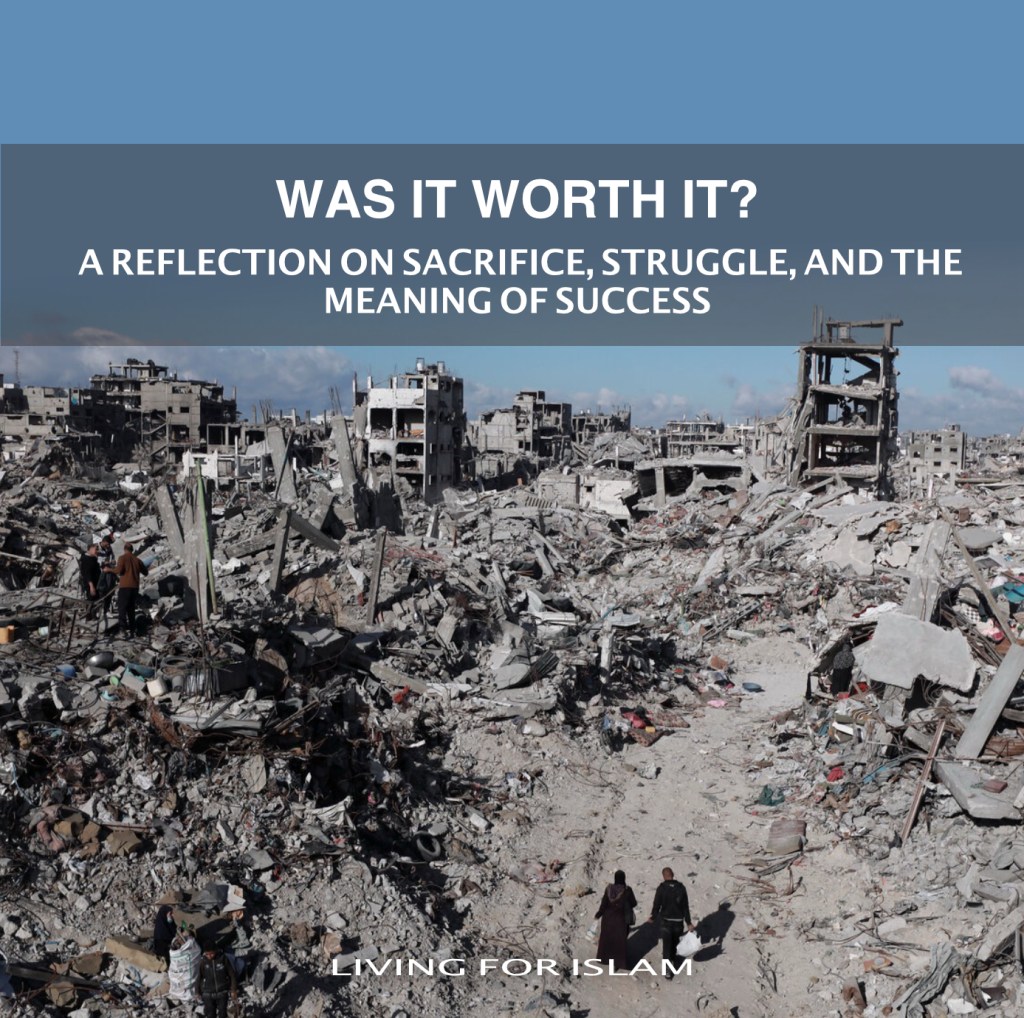
HOW MANY LIVES were lost? How much destruction did we witness? In the face of such immense pain and devastation, I hear many asking a question: Was it worth it? And what, if anything, was truly gained?
The answer depends entirely on how we define success.
For those who view this world as the only reality, success is measured in power, wealth, and stability. It’s a transactional view, one where comfort is the ultimate goal and sacrifice is seen as wasteful. Under that worldview, even something like Trump’s “peace plan” makes sense. He offers Palestinians economic development, infrastructure, leisure, and a sense of security. On paper, it looks like a better life.
But at what cost?
As a believer, I can’t accept that metric. My worldview is shaped by the conviction that this life is temporary, and that true success lies in the akhirah, the eternal Hereafter. I believe we’re accountable not just for what we build, but for what we uphold. And if achieving worldly comfort requires compromising the rights of the oppressed or forsaking core principles, then no amount of prosperity can make it worthwhile.
From that lens, the suffering we’ve witnessed is not meaningless. The pain endured may, in fact, carry purpose. Trials, when borne with sabr, tawakkul and iman, can become vehicles for eternal reward. That doesn’t mean we welcome suffering, but it does mean we see through it. We believe that justice, even if delayed, is never denied by the One who sees all.
That doesn’t mean I dismiss this world entirely. We still act. We still strive. Justice matters here and now. And when I look back at the past two years, I see that not everything was in vain.
If a goal was to ensure the Palestinian cause remained alive, especially when many nations rushed to normalise relations with Israel under the Abraham Accords, then that goal was unquestionably met. The idea that Palestine could be traded for investments or political favours has been rejected. Millions across the globe were reminded: Palestine will not be given away for free.
And if another aim was to challenge the myth of Israeli military invincibility, then October 7th marked a profound rupture. Regardless of what unfolded that day, one fact is indisputable: the narrative of absolute Israeli power and control was shattered. The scale and intensity of Israel’s response, in part, appear to be an effort to restore that illusion.
But the past two years have also revealed a devastating failure.
The deafening silence of the Muslim world cannot be ignored. While Gaza was pummeled, its people starving and besieged, the governments of Muslim nations stood by. Their passivity wasn’t just a strategic choice; it was a moral failure. Their inaction spoke volumes.
And yet, amidst all this, I’ve come to believe that something greater is unfolding, something no government or institution can fully control.
وَيَمْكُرُونَ وَيَمْكُرُ ٱللَّهُ ۖ وَٱللَّهُ خَيْرُ ٱلْمَـٰكِرِينَ
“They plan, and Allah plans. And Allah is the best of planners. (al-Anfal 30)
This verse continues to echo in my mind. It reminds me that even when powerful actors scheme and manipulate, Allah’s wisdom prevails. What looks like chaos may be laying the groundwork for awakening. What feels like defeat may be planting the seeds of transformation.
Who could have imagined that Western hypocrisy would be laid so bare? The supposed guardians of international law and human rights revealed how selectively those values are applied. The global south, in particular, watched closely as the “rules-based order” collapsed under the weight of double standards. The image of Israel as a democratic, moral state faltered, not because of propaganda, but because of the realities of genocide broadcast for all to see.
Many of us also began to reckon with hard truths about our own leadership. We saw more clearly than ever before how many Muslim rulers do not represent the interests of their people, or of Islam, but instead protect a colonial-era system designed to strengthen the enemy and fragment us. The modern nation-state, as it exists in much of the Muslim world, functions more as a barrier to unity than a vehicle for justice.
I see signs of that transformation now. The world is changing. Illusions are breaking down. People who once looked away are beginning to see. Conversations that were once fringe are becoming mainstream. The cracks in the system are no longer hidden—they are visible, undeniable, and growing.
But awakening is only the first step. Recognition alone is not enough. If we are truly to honour the sacrifices made, if we believe they were not in vain, then we must act.
That means challenging corrupt leadership. That means questioning borders that divide us. That means working to re-establish Islam as a complete way of life, one that governs not just our private rituals, but our public systems: political, economic, and moral.
Only then, I believe, can true justice be realised.
Only then will Palestine be free.
 Living For Islam