

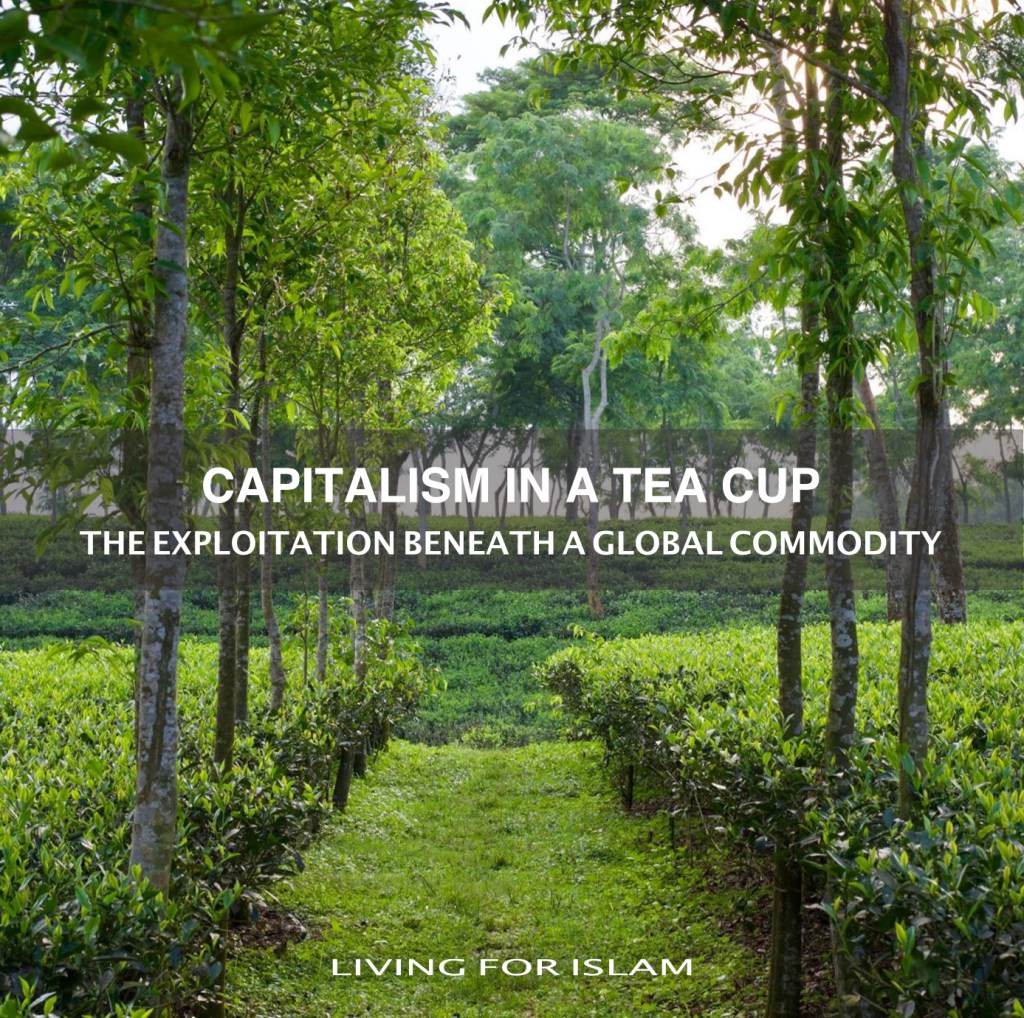
IF YOU’VE EVER travelled to Sylhet in the northeast of Bangladesh, it’s hard not to be captivated by the beauty of its tea gardens. The dark green terraces stretch across rolling hills, occasionally shaded by tall trees, creating a landscape that is as serene as it is breathtaking.
But behind this calm, green elegance lies a disturbing history, a legacy of exploitation and injustice that dates back to British colonial rule.
The Dark History Behind the Beauty of Bangladesh’s Tea Gardens
In the 17th and 18th centuries, tea emerged as a national obsession in Britain. At the time, China was the world’s primary source of tea, and the British East India Company imported vast amounts of it in exchange for silver and other goods. This arrangement, however, soon became a problem for the British. China tightly controlled the trade and demanded payment in silver, which began to deplete Britain’s reserves.
In a desperate attempt to reverse the trade imbalance, the British began smuggling opium into China, fuelling widespread addiction. This strategy led to the infamous Opium Wars of the mid-19th century, a violent and morally bankrupt response to an economic challenge.
Determined to free themselves from dependence on Chinese tea, the British began searching for alternative sources. They turned to their colonies, particularly India and later what is now Bangladesh, hoping to cultivate tea for themselves.
The Birth of South Asia’s Tea Industry
To kickstart local production, British botanists and officials smuggled tea seeds and plants out of China. Around the same time, wild tea plants were discovered in the Assam region of India. The British soon established large plantations in Assam, Darjeeling, and eventually in the Sylhet and Chittagong Hill Tracts (areas now part of modern-day Bangladesh).
These plantations were not built with the welfare of local communities in mind. They were created to serve British economic interests, and they operated on a system of extreme inequality. British companies oversaw the estates, but as slavery had been abolished, the labour was done by impoverished workers brought in from other parts of India. These labourers were often promised decent work and better lives, but instead found themselves trapped in conditions that closely resembled bonded labour. They worked long hours for meagre wages, with little or no rights, and were not allowed to leave the plantations without permission.
Land Seizure and Social Marginalisation
To build these tea estates, the British cleared vast areas of forest and forcibly took land from indigenous communities. In many cases, families were evicted from their ancestral lands without compensation. The British then passed laws to legitimise these land grabs, converting communal land into private property controlled by colonial companies.
The workers brought in to staff the plantations—mostly from tribal areas in Bihar, Orissa, and Andhra Pradesh—were socially isolated from local populations. They were housed in segregated quarters known as “labour (coolie) lines” and cut off from broader society. Over generations, these communities became a distinct and marginalised group, with limited access to education, healthcare, or social mobility. Poverty, rather than prosperity, was passed down through families.
While Britain profited enormously by exporting tea to Europe, the workers and local communities received almost nothing. The wealth generated by the industry was siphoned off to Britain, and very little was invested in the regions or people who produced it.
Post-Colonialism Without Real Change
When British rule ended in 1947, and later, when Bangladesh gained independence in 1971, one might have expected the tea workers’ conditions to improve. In reality, the system of exploitation largely remained intact.
Ownership of tea estates shifted from British companies to local elites, government agencies, and private corporations. But the underlying structure, low wages, poor living conditions, and social exclusion, barely changed. The descendants of those original labourers continued to work on the plantations under almost identical conditions. Many still do today.
Although Bangladesh became an independent nation, it remained tied to global markets that favour wealthier countries. Tea continued to be exported to Europe and North America, often at premium prices. But the workers who cultivated and picked the tea received only a tiny share of its value. The bulk of the profits went to local estate owners, global tea brands, and multinational corporations that managed the packaging, branding, and distribution.
Western corporations, in particular, exerted pressure on local producers to keep costs low. That translated into persistently low wages for workers, many of whom still earn less than the legal minimum. Despite the growing popularity of “ethical” or “fair trade” teas, the benefits of such initiatives rarely reach the labourers themselves. In many cases, Western consumers are sold the image of sustainable or humane practices, while the reality on the ground remains one of deprivation and injustice.
The global tea industry continues to rest on foundations built during colonialism, with the West still benefiting from systems of exploitation it helped create.
Can Islam Offer an Ethical Alternative?
The injustice behind the tea industry raises an important question: can Islam, with its ethical and economic teachings, offer a meaningful solution?
At its core, Islam is built on divine principles of justice, fairness, and compassion. The Qur’an repeatedly commands believers to stand up for justice, even if it means speaking out against one’s own community or self-interest. This sense of moral accountability is deeply incompatible with the exploitation of labour and the abuse of economic power.
Islamic economics makes clear the rules and limits of hiring and partnerships. The Messenger ﷺ emphasised the fair treatment of workers, famously instructing employers to pay wages before the sweat dries from a labourer’s brow. In Islamic ethics, workers are not mere tools of production; they are human beings whose dignity must be respected. Under such a system, tea workers would be guaranteed fair wages, humane working hours, and safe, healthy living conditions.
Islam also views ownership as a trust, not an absolute right. Those who hold wealth are accountable to Allah for how they use it. Hoarding wealth or enriching oneself at the expense of others is condemned. Business, in Islam, is not just about profit; it is about mutual benefit and moral responsibility.
The system of zakat, or obligatory charity, is another powerful tool for reducing inequality. It ensures that a portion of wealth is redistributed to the poor and vulnerable.
Furthermore, Islam prohibits riba, usury and exploitative financial practices, and demands fairness in trade. The kind of profit-maximising model that defines modern global capitalism, where human cost is ignored, directly contradicts Islamic teachings.
Islam certainly provides a comprehensive framework that not only condemns exploitation but also actively works to prevent it. The challenge, however, lies in practice.
The sacred text has to be taken out of the books and made a reality, not just for the tea industry but for every industry that is being corrupted by capitalism.
The current corruption and entrenched economic interests of the elite and foreign corporations need to be replaced by sincere leadership based on the Islamic system (the Khilafah), which will bring legal reforms, public accountability, and a cultural shift toward prioritising justice over short-term profit.
A Final Reflection
The tea gardens of Sylhet may appear serene and beautiful, but beneath their surface is a long and painful history of land dispossession, labour exploitation, and generational poverty. Although colonial rule ended decades ago, the systems of inequality it created continue to shape the present. Capitalism, in its relentless pursuit of profit, is destroying people and the planet.
Islam, as a political, economic and social system, offers a powerful counter-narrative, one rooted in truth and justice. If applied sincerely, its principles could help dismantle the legacy of exploitation and bring harmony between people and the environment.
But until that happens, until Islam is placed at the centre of political and economic life, the suffering of Bangladesh’s tea workers will remain hidden behind the green veils of its hills.
 Living For Islam