
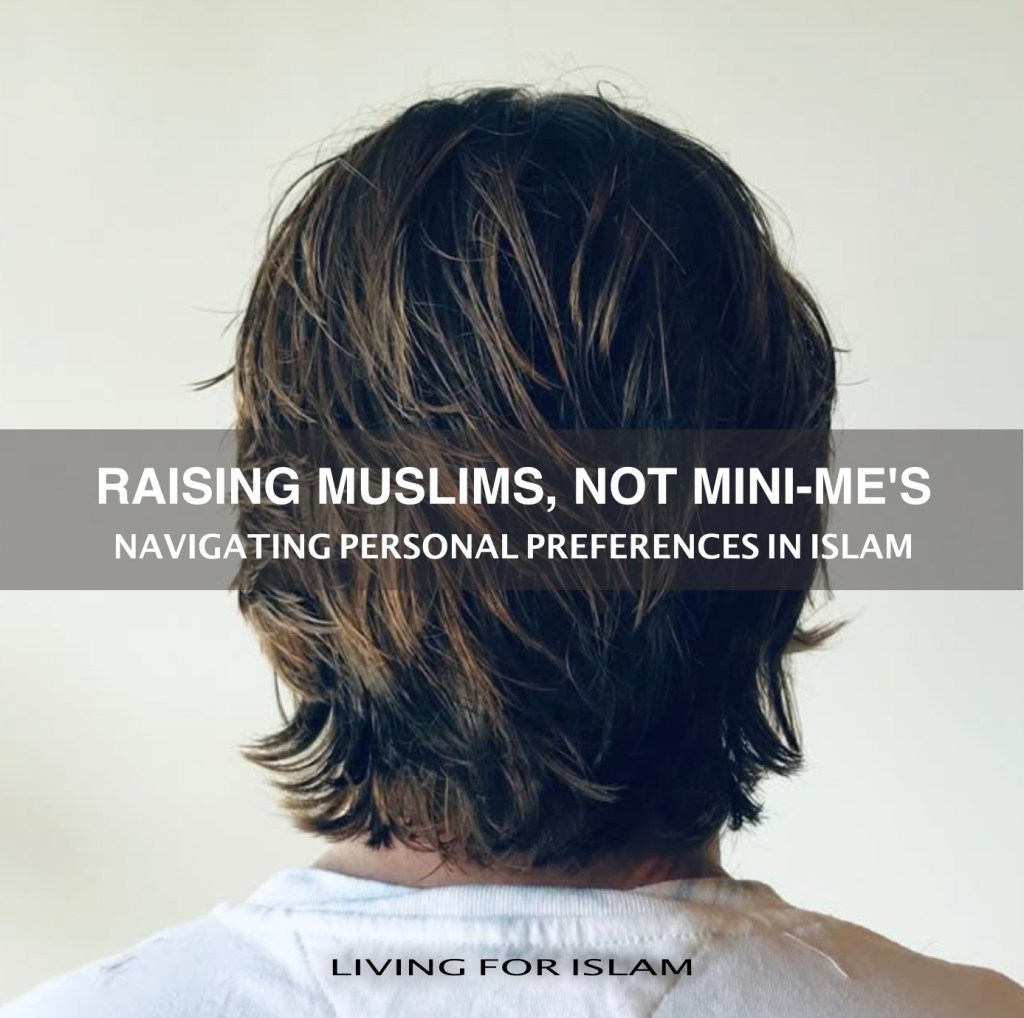
RECENTLY, SOMEONE COMPLAINED to my parents about the length of my son’s hair (somewhere below his earlobes but above his shoulders), saying: “Children of good families don’t keep their hair long.”
If I were to ask my son, now 19, to respond, he’d probably be surprised. He might remind them that the Messenger Muhammad ﷺ himself kept his hair long at various times. It’s authentically reported that his hair would reach his mid-ear, earlobes, and even shoulders, depending on the time and circumstances and at times it was non-parted, at times parted and at times braided.
Moreover, during Hajj and Umrah, the Prophet ﷺ shaved his head as part of the ritual acts.
So clearly, hair length is left open to a degree in the Prophetic tradition. And if we believe that the best example for a Muslim is the example of the Prophet ﷺ, as Allah commands in the Qur’an:
لَّقَدْ كَانَ لَكُمْ فِى رَسُولِ ٱللَّهِ أُسْوَةٌ حَسَنَةٌۭ
Indeed, in the Messenger of Allah you have an excellent example… (al-Ahzab 21)
Then how can we claim that growing one’s hair out, something the Prophet ﷺ himself did at times, reflects poorly on one’s family or upbringing?
To make such a judgment is not only baseless but reflects a shallow understanding of religion, awareness of the times we live in, and, dare I say, poor parenting.
Personal Preference vs. Divine Guidelines
Let me be honest: I personally don’t like long hair. I find it impractical and not to my taste.
But my son isn’t me. He is him. And Islam, in its wisdom, gives us guidelines and boundaries, not rigid moulds for personality or taste.
As long as we remain within the limits set by Allah, and He gives a wide space, then personal expression is not only allowed but respected. It is not for me, or anyone else, to impose my personal likes or dislikes in areas where Islam allows flexibility.
Insisting on obedience in such matters, which may be nothing more than a transitory phase, can create unnecessary tension and rebellion. It risks breaking trust and losing influence, what I’d call ‘relational capital’, with our children. That capital is essential for times when we do need to enforce boundaries—when actual lines of halal and haram are crossed.
Choosing the Right Battles
We must learn to choose our battles wisely.
There is a profound difference between disagreeing with my son’s hairstyle and confronting him if he were to, say, organise his wedding filled with dancing, free mixing, and blatant disregard for hijab and modesty, as has sadly become normalised by many Muslims these days.
One is a matter of taste, the other a matter of transgression.
As parents, our job is not to crush individuality but to guide our children with wisdom, focusing on the issues that truly matter in the sight of Allah.
Final Reflection
The Messenger ﷺ didn’t raise clones. He raised companions—men and women of deep faith and unique personalities. As long as our children remain within the boundaries of Islam, we must honour their differences and nurture their individuality. That is the prophetic way.
Let us not confuse cultural norms with religious values. And let us not lose the war by picking the wrong battles.
 Living For Islam