
WITH DECLINING BIRTH rates and ageing populations, Western societies are becoming increasingly dependent on shrinking workforces and all the issues that arise from that.
But Bangladesh is blessed with a different reality. Our population of 175 million includes a powerful asset: a young, energetic, and growing generation, with half of the population under 27 years old.
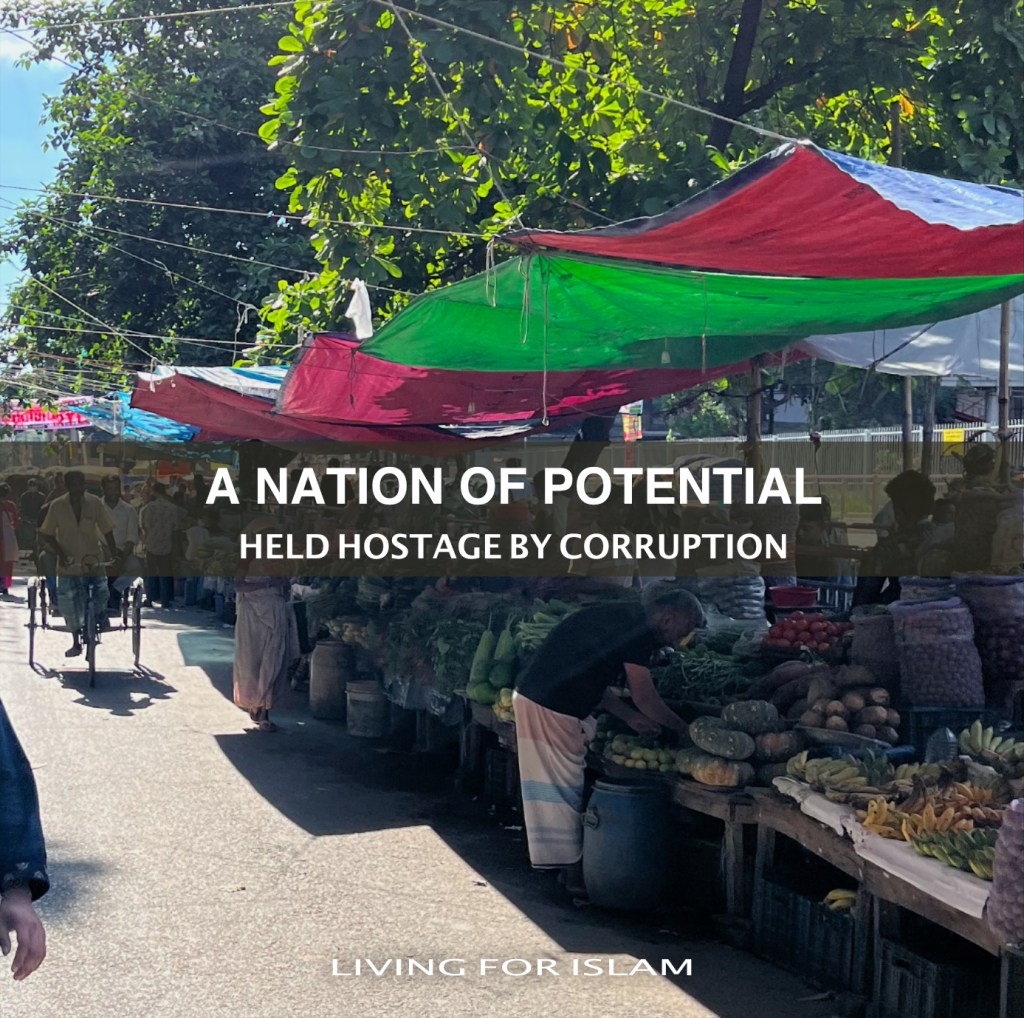
As I walk through the streets of Dhaka, I’m moved by the resilience and entrepreneurial spirit of our people. From roadside stalls to makeshift booths in alleyways—even on highway medians—our people are hustling, innovating, and striving to survive.
Yet with all this energy and potential, why are we still not rising as a nation?
The answer that many will give is brutally simple: corruption.
What Corruption Does to a Nation
No one is born corrupt. Rather, it is the system that makes them corrupt. This systemic corruption poisons every institution it touches: education, employment, business, law, and leadership. It erodes public trust, kills initiative, and suffocates potential.
1. It Steals Job Opportunities
Bribery, nepotism, and favouritism mean jobs do not go to the most qualified, but to the most connected. This blocks skilled individuals, increases unemployment, and stifles progress.
We saw recently how, under the Hasina government, the quota system was exploited to place loyalists in civil service jobs. The injustice led to the mass student uprising, the death of 1,400 youth, and eventually her government’s collapse. A system that ignores merit is a system destined to fall.
2. It Destroys Motivation and Drives ‘Brain Drain’
When promotions and salaries are based on bribes instead of performance, people lose hope. The best minds leave, creating a devastating brain drain.
We see that most of the country’s educated youth want to leave and have seen thousands of Bangladeshi doctors, engineers, and IT professionals migrate to countries like Canada, Australia, and the UK—because they seek fairer systems where hard work is rewarded.
3. It Corrupts Education
Fake degrees, paid-for grades, and bribed teachers produce an underqualified workforce. The entire foundation of development—knowledge—is compromised. What future can we build on lies?
4. It Robs the Nation’s Wealth
Corrupt officials steal billions that could have been used for schools, hospitals, roads, and training centres. Instead, it lines private pockets. Infrastructure projects such as the Padma Bridge scandal exposed how political elites siphoned off funds through shell companies. The poor pay the price for elite greed.
5. It Exploits Workers
Corruption in labour enforcement leads to deadly factory conditions. Fire exits blocked. Safety ignored. Lives lost. All for profit. The Rana Plaza collapse in 2013 killed over 1,100 garment workers. Corrupt inspectors allowed the 8-story building to operate despite visible cracks in the walls.
6. It Repels Investment
No honest investor wants to put their money in a corrupt economy. Businesses avoid the instability and unpredictability that corruption causes. This leads to fewer jobs, less growth, and more poverty.
Bangladesh’s rank in Transparency International’s Corruption Perceptions Index remains alarmingly low, coming 151st out of 180 countries, scaring away billions in potential foreign investment.
Islam: The Proven Solution to Corruption
Corruption is inevitable in all secular systems, be it democratic, socialist, or military rule because it is dependent on humans making the laws. It happens in Bangladesh and across the world even in so called advanced countries. What differs is how sophisticated and legalised it becomes. For example, what might be a bribe in one country is rebranded as a £1,000 fundraising dinner in another.
In contrast, Islam offers a complete, time-tested, and moral framework to fight corruption that permeates every level of our thinking and society.
For instance, the Qur’an explicitly forbids bribery:
وَلَا تَأْكُلُوٓا۟ أَمْوَٰلَكُم بَيْنَكُم بِٱلْبَـٰطِلِ وَتُدْلُوا۟ بِهَآ إِلَى ٱلْحُكَّامِ لِتَأْكُلُوا۟ فَرِيقًۭا مِّنْ أَمْوَٰلِ ٱلنَّاسِ بِٱلْإِثْمِ وَأَنتُمْ تَعْلَمُونَ
“Do not consume one another’s wealth unjustly or send it (in bribery) to the rulers so that they might aid you to consume a portion of the wealth of others while you know it is unlawful. (al-Baqarah 188)
The Messenger ﷺ said: “Allah has cursed the one who offers a bribe and the one who accepts a bribe to receive a favourable judgment.” (Ahmad)
There are no excuses, no legal disguises. Bribery in Islam is a sin, plain and simple.
Muhammad ﷺ was known as Al-Ameen, the Trustworthy. He never compromised on honesty, even when it endangered his life. Even as he left Makkah, pursued by the Quraysh, he ensured that items left in his trust were returned to their owners. Such was his moral integrity.
In leadership, the Messenger ﷺ said: “Each of you is a shepherd, and each of you is responsible for his flock.” (Bukhari)
Leaders must serve the people, not exploit them. Justice is a sacred duty, not a political slogan.
As the state grew, we find the khulafah introducing administrative rules to counter corruption.
Umar ibn Al-Khattab (ra) regularly audited governors’ wealth to prevent illegal enrichment. He would dismiss officials at the first sign of corruption.
His descendant, Umar ibn Abdul Aziz, drew a clear distinction on the personal use of public property by officials. He forbade his relatives from misusing public funds, and he returned the stolen wealth to the Bait al Maal (public treasury)
This was leadership with fear of Allah and love for justice.
Islam also has inbuilt mechanisms to counter the tendencies to corruption. For instance, it obligates Zakat and encourages voluntary charity (Sadaqah), promoting wealth redistribution and discouraging greed, hoarding, and corruption by reminding believers that wealth is a trust from Allah.
The Heart of Anti-Corruption: Taqwa (God-Consciousness)
The root of justice is taqwa—awareness or mindfulness of Allah. To give an example, during a night patrol, Umar (ra) overheard a mother telling her daughter to dilute milk with water. The girl replied: “Umar won’t see us, but Allah sees us.”
This awareness of divine accountability drives Muslims to uphold justice and reject corruption, even when human oversight is absent.
Conclusion: It’s Time to Turn Back to Islam
The Ummah must recognise that only Islam offers a comprehensive, values-based system to combat corruption effectively. If we genuinely seek to overcome our current challenges, we must turn away from secular political systems that have failed us for decades and return sincerely to Islamic principles.
We have the manpower. We have the talent. We have the resources. Through sincere leadership, justice, transparency, and accountability grounded in Islam, our society can flourish—free from corruption and full of opportunity.
The time is now. Let’s rebuild our future—with Islam as our foundation.
 Living For Islam