
“WHAT DO YOU think? Dhaka has changed a lot since you last came. It’s very developed now.”
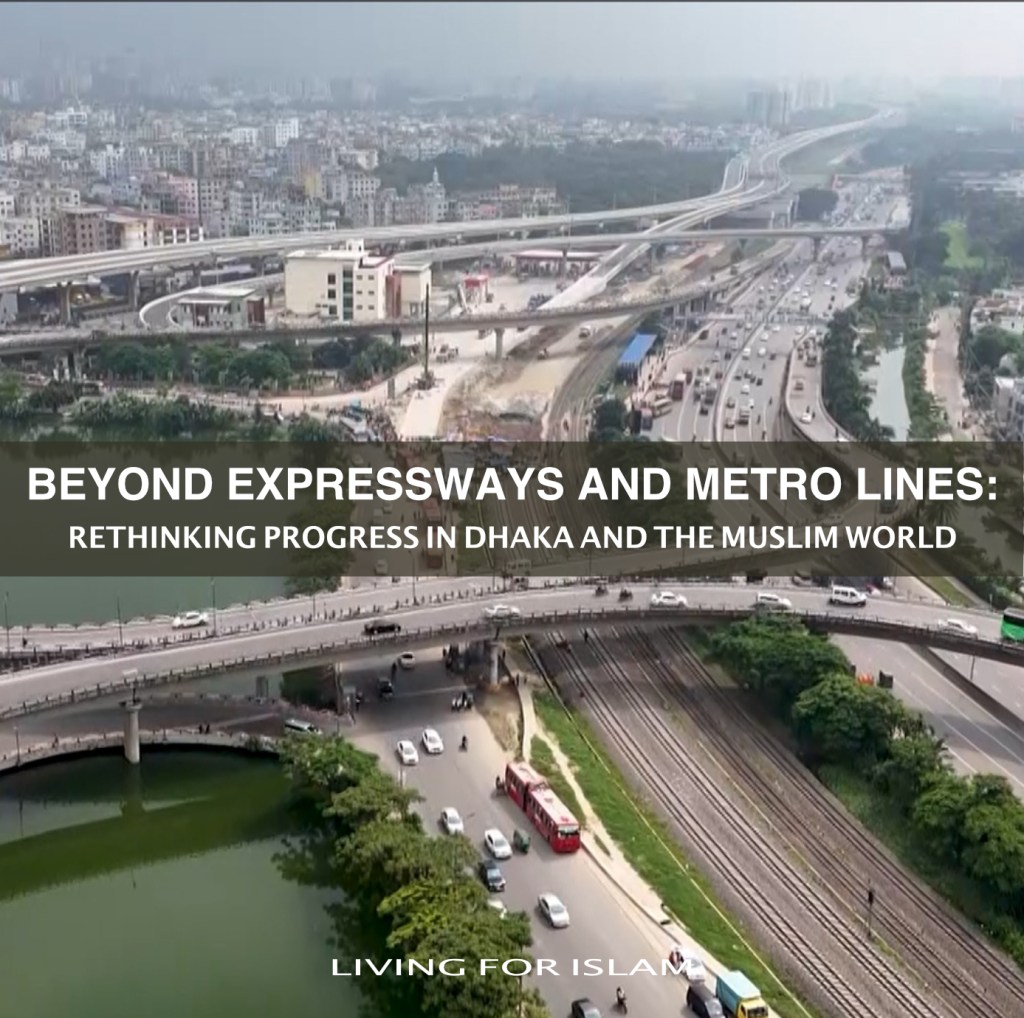
We had just landed and were already speeding along the new Dhaka Elevated Expressway. What once took nearly two hours in gridlocked traffic was now a smooth 20-minute journey. High-rises now punctuate the skyline. The metro—with a stop near our house—has improved connectivity across the capital.
It’s true—Dhaka has changed. It’s not quite Dubai or Doha, but in terms of infrastructure, there’s undeniable progress.
Yet we must ask: What does this development really mean? And more importantly, how should we evaluate it?
1. Infrastructure Is a Duty, Not a Favour
Many credit the previous government for these infrastructure projects. But let’s be honest—these developments were long overdue. They are not favours to the people, but the bare minimum responsibilities of any government.
The Prophet Muhammad ﷺ said: “Surely, every one of you is a shepherd and every one is responsible for his flock. The ruler is a shepherd and is responsible for his subjects… (Bukhari)
Governing isn’t about cutting ribbons or having roads named after you. It’s about accountability—using public resources to meet public needs, honestly and efficiently.
And yet, as everyone knows, behind these mega-projects lie corruption, inflated costs, and contracts funnelled to political allies. This is not progress; it’s plunder disguised as development. The Expressway was financed by Chinese conglomerates and the Metro by the Japanese- these will have to be paid on their terms and is not without cost.
We would do well to remember the words of Umar ibn al-Khattab (ra): “If a lost sheep under my care were to die on the banks of the Euphrates, I would expect Allah the Exalted to question me about it on the Day of Resurrection.” (Ḥilyat al-Awliyā’)
This is the Islamic standard of leadership, and the ummah needs to up its expectations. We cannot allow our loyalty to be bought by these projects whilst turning a blind eye to the corruption and tyranny.
2. What Truly Brings Honour to a Nation?
Is honour found in elevated highways and glass buildings? Or is it something deeper?
When Umar (ra) went to receive the keys of Jerusalem, he wore a patched cloak. His companion Abu Ubaidah (ra) suggested he dress more formally to impress the Christian leaders. Umar (ra) replied: “We were a disgraceful people, and Allah honoured us with Islam. If we seek honour from anything other than what Allah honoured us with, Allah will disgrace us.” (al-Mustadrak)
This incident gives us a clear framework: real honour comes from adherence to Islam, not imitation of others.
The pre-Islamic Arabs were tribal, fragmented, and insignificant. But within a single generation of the Messenger ﷺ establishing the Islamic state in Madinah, the Muslims had unified Arabia and overtaken both the Persian and Byzantine Empires.
How? Not with highways, skyscrapers and sporting events? But with an aqeedah that gave them clarity, purpose, and a values-driven system to govern by.
From this foundation arose a civilisation that led the world in justice, knowledge, science, and ethics for centuries.
Islamic thought came first. Material progress followed.
3. The Mirage of Modern Development
Today, we see elevated highways and metro systems, but the deep contradictions are visible to anyone looking.
On the same Dhaka road where a luxury SUV glides through town, a barefoot child rummages through garbage for food. Economic inequality is as obvious as the skyline.
Despite the development, corruption continues, economic insecurity grows, and the country remains at the mercy of foreign interests.
After the fall of Sheikh Hasina last year, many hoped for meaningful change. But that hope is quickly fading. The opposition—long part of the two-party musical chairs—now prepares for its turn to loot the country. It seems the cycle of exploitation remains uninterrupted.
This story isn’t unique to Bangladesh. Across the Muslim world—from Qatar to the UAE to Saudi Arabia—we see a similar obsession with material progress. Tall buildings, mega projects, international events… but beneath it all lies a void.
No one looks to these nations for moral, intellectual, or ideological leadership. They have the resources, but not the ideas.
4. Who Really Leads?
Take a crude but telling example: your iPhone. Designed in California, manufactured in China. The intellectual leadership lies in the West. That’s where decisions are made, innovation happens, and profits accumulate.
They lead with thought. Others follow with labour.
Likewise, the West dominates today by promoting its belief systems—freedom, secularism, capitalism—and compelling the world to follow. These ideas shape global politics, economics, education, and media.
What’s our response?
The Muslim leaders do nothing to counter these ideas. They adopt them. Imitate them. Celebrate them. In doing so, they waste our potential and resources and keep us locked in cycles of dependency.
When you don’t have your own thinking, you’re left with imitation. And imitation is not leadership—it’s intellectual colonisation.
5. A Return to the Source of Honour
Only Islam gives us a worldview that uplifts us—spiritually, socially, and politically. It instils humility in rulers, who serve without seeking praise or popularity. Purpose in society, grounded in truth, justice and accountability. Vision in individuals, where success is measured by obedience to Allah and furthering His Cause, not GDP.
We must not be deceived by outward appearances. Material infrastructure is important—but it must be guided by values, justice, and vision.
Only Islam offers a holistic solution—freeing us from corruption, insecurity, and foreign interference, and enabling us to truly progress.
If we are to reclaim our dignity as a people, it will not be through roads and railways alone. It will be through a revival of Islamic thought, governance, and purpose.
Conclusion
Yes, Dhaka has changed. I barely recognise it from the Dhaka of the 80s, where I grew up. But real change is more than expressways and metro lines. Real change is intellectual, firmly grounded in the spirit. Until we decolonise our minds and society and return to the source of our true honour, Islam, we will remain stuck in a cycle of imitation and decline.
 Living For Islam