

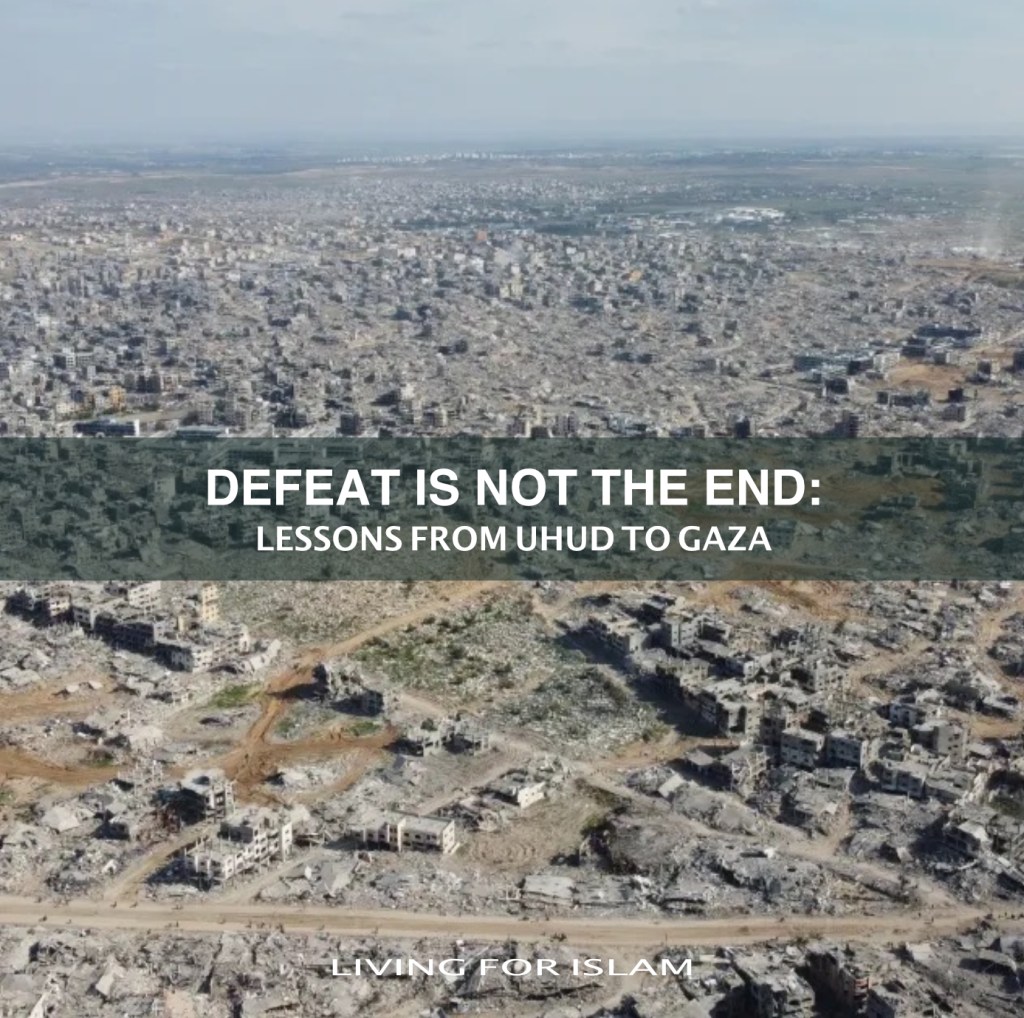
HAVE YOU EVER thought about why Allah included so many battles and events in His Book?
From Badr and Uhud to Ahzab, Banu Nadir, Khaybar, the Conquest of Makkah, Hunayn, and Tabuk—these events are not just history; they offer important lessons that remain relevant today.
Why? Life is filled with tests and tribulations. And until the Last Day, we will continue to face trials that echo those of the past.
Yet in the Qur’an, Allah gives us comfort and guidance. Its verses offer direction in tough times and clarity in confusion.
Over the past 22 months in Gaza, we feel helpless in the face of endless brutality, despite our numbers, resources, and sincere prayers. This follows a century of hardship for the ummah, with continuous defeats, occupations, and oppression.
But let’s pause here: defeat is not unknown to our history.
The Battle of Uhud, for instance, delivered a painful blow to the early Muslims. And in Surah Āle ‘Imrān, Allah addresses this very defeat, breaking it down and extracting powerful lessons to reshape our mindset for future challenges.
At Uhud, the Muslims were on the brink of victory. But in a moment of haste, some archers abandoned their posts, eager for the spoils of war. Their flank left exposed, Khalid ibn al Walid—then still a disbeliever—saw his chance. He led a counterattack that turned near victory into a devastating setback. Beloved companions like Hamza (ra), the Prophet’s ﷺ uncle, and Mus‘ab ibn ‘Umayr (ra), the first ambassador of Islam, were martyred.
The seerah reveals the intensity of the battle and the deep anguish that followed. Even the Prophet ﷺ was wounded. The emotional and physical toll was immense.
Yet from this painful moment, Allah revealed verses to instruct and console. And from these verses, scholars draw a profound conclusion: though Uhud appeared as a loss, it became a victory for the ummah, because it taught us how to process defeat and rise stronger.
1. Reflect on History
Allah begins with a reminder of those who came before:
قَدْ خَلَتْ مِن قَبْلِكُمْ سُنَنٌۭ فَسِيرُوا۟ فِى ٱلْأَرْضِ فَٱنظُرُوا۟ كَيْفَ كَانَ عَـٰقِبَةُ ٱلْمُكَذِّبِينَ
Many similar ways (and mishaps of life) were faced by nations who have passed away before you; so travel through the earth, and see what was the end of those who disbelieved. (Āle ‘Imrān 137)
This is a call to reflect, to observe the patterns of history. Think of ʿĀd, Thamūd, and the many who defied divine truth. Their end was the same: destruction.
History teaches us that the struggle between truth and falsehood, belief and disbelief, justice and oppression is ongoing. In this struggle, there are victories and losses. But in the grand scheme, the ultimate losers are those who rejected Allah—the mukadhibīn.
So when we face setbacks, we must remember: the ummah’s story is not one of perpetual defeat.
If it were, then how did Islam reach every corner of the world if all we ever did was lose?
What of the victories at Badr, Ahzab, Tabuk, Fathe Makkah, Qādisiyyah, ʿAyn Jālūt, Ḥiṭṭīn, and the opening of Constantinople?
We’ve had triumphs. And we’ve faced loss. That is the reality of any struggle. Victory and defeat are both part of the test.
Allah ﷻ says:
هَـٰذَا بَيَانٌۭ لِّلنَّاسِ وَهُدًۭى وَمَوْعِظَةٌۭ لِّلْمُتَّقِينَ
This is a clear statement for humanity, a guidance and an instruction for those who are mindful of Allah. (Āle ‘Imrān 138)
2. Adopt the Right Mindset
Then Allah addresses the believers directly:
وَلَا تَهِنُوا۟ وَلَا تَحْزَنُوا۟ وَأَنتُمُ ٱلْأَعْلَوْنَ إِن كُنتُم مُّؤْمِنِينَ
Do not weaken, nor grieve, for you will be superior—if you are true believers. (Āle ‘Imrān 139)
Imagine the emotional weight on the sahaba after Uhud: mourning their dead, nursing their wounds, and questioning what went wrong.
Allah speaks to their hearts. He tells them, and us, not to give in to despair. Not to let grief paralyse us. The battlefield loss was temporary. But a spiritual defeat, a loss of conviction, is far more dangerous.
True defeat is when we internalise the idea that we are powerless. When we start believing we’re destined to lose. That the systems of disbelief are too mighty, too sophisticated, too entrenched to ever be overcome.
But Allah affirms: You are superior, if your belief is sincere.
Our strength lies not in numbers or wealth or technology, but in īmān and dīn. Our moral clarity, our connection to divine guidance, is what elevates us.
And so the Prophet ﷺ and his companions were reminded: do not let a setback define you.
3. Beware the Real Defeat: A Broken Mindset
Today, the greatest goal of those who oppose Islam is not merely the destruction of buildings or lives. It is this erosion of our mindset.
How often have we heard:
“We can’t change anything.”
“The West is too powerful.”
“The Muslim world is hopeless and divided.”
“Just focus on yourself—nothing can change.”
“It’s the end times. The Mahdi will sort it out.”
This defeatist narrative has been fed to us through carefully crafted messaging, political, cultural, and even educational. The aim? To make us doubt Islam, not in prayer or fasting, but in its ability to guide politics, economics, leadership, and societal matters.
You won’t find Muslims copying non-Muslims in salah, or visiting temples to learn their ways of worship. We trust Islam when it comes to ibādah.
However, in terms of ruling, politics, economics, and societal matters, many Muslims may not know or may doubt whether Islam is suitable for the present time. Can Islamic economics reduce poverty and build a fairer world? Can Islamic politics provide fairness, responsibility, and effective leadership? Can Islam create a global system where laws truly matter? Is the punishment system too severe, and is Islam’s stance on family life too limiting?
Do we believe Islam has solutions? Or do we turn to liberalism, democracy, the UN, parliaments, and human-made systems to fix what’s broken?
This hesitation, this internalised doubt, is the real damage caused by continuous defeat. A damage not of land or life, but of conviction.
And yet, Allah demands that we resist such thinking. He calls us to a mindset of strength, rooted in certainty that Islam is not just a religion of rituals, but a complete way of life, capable of leading humanity with justice, mercy, and wisdom.
This is how we overcome defeat: through unwavering iman, clear understanding, and revived confidence in Islam.
3. A Practical Mindset in the Face of Loss
After the shock of Uhud, Allah continues to address the Believers with profound clarity and realism:
إِن يَمْسَسْكُمْ قَرْحٌۭ فَقَدْ مَسَّ ٱلْقَوْمَ قَرْحٌۭ مِّثْلُهُ
If a wound has touched you, be sure a similar wound has touched the others. (Āle ‘Imrān 1 40)
The loss at Uhud was heavy—70 noble companions martyred, many others injured, and the morale of the ummah shaken. But Allah reminds us: the pain you feel is not unique. The Quraysh too have bled—just one year earlier at Badr, they lost some of their most influential leaders.
And yet, they returned. They regrouped, refocused, rebuilt their army, and marched again. They refused to be paralysed by defeat.
So why should the Muslims be disheartened? If the disbelievers can rally for a cause rooted in falsehood, how much more should we rise for the truth? We fight not for pride or territory, but for the message of Islam, the justice of tawḥīd, and the guidance of humanity.
This is a divine lesson in resilience and practicality.
Reflect on the past century. During the World Wars, many nations, Germany, Britain, Japan, Russia, and China, were devastated. They lost people, power, and prestige. Yet, within decades, they rebuilt. They emerged again, not because of divine support, but because they believed in their systems, united around their ideologies, and worked towards recovery.
And yet, the Muslim ummah, despite having the truth, remains weak.
Why? Because our wounds were deeper. Not just material, but ideological. After the fall of the Ottoman Khilafah, Islam was stripped of its role in governance, law, economics, and statecraft. It became reduced to private rituals—something personal, not societal.
While other nations rebuilt around their secular ideologies, we abandoned our own divine way of life.
Allah continues:
وَتِلْكَ ٱلْأَيَّامُ نُدَاوِلُهَا بَيْنَ ٱلنَّاسِ
And these days (of varying conditions) We alternate among the people. (Āle ‘Imrān 140)
Victory and defeat are not permanent. They rotate. This is the Sunnah of Allah in history. Not every battle will be a Badr, and not every moment a loss like Uhud. We, as Muslims, are taught to have a balanced and realistic outlook.
We are not doomed to defeat, our history says otherwise. Of 1,400 years, these last 100 have been a dip, a temporary downturn. If Muslim history were a single day, our current struggles would represent less than two hours. We must zoom out and remember: we’ve had more success than failure.
Islam lives on every continent. 1.8 billion people proclaim lāa ilāha illa Allāh. The setbacks are temporary. The promise of Allah is eternal.
4. The Divine Wisdom in Defeat
It’s easy, amid loss, to fall into despair. But Allah reframes our vision:
وَلِيَعْلَمَ ٱللَّهُ ٱلَّذِينَ ءَامَنُوا۟
That Allah may test those who believe… (Āle ‘Imrān 140)
Iman is not proven in peace, but in pressure.
Uhud exposed the reality of people’s hearts. One-third of the Muslim army—led by the hypocrite ‘Abdullāh ibn Ubayy—abandoned the Prophet ﷺ just before battle. Imagine the morale drop! Facing a formidable enemy, and suddenly, a third of your side walks away. Uhud exposed the hypocrites and those of weak iman.
The past 100 years have been such a test. Each defeat is a testimony to who is on the side of Allah and who betrayed the cause. Like Gaza is revealing who truly believes today from the masses, the scholars, the rulers etc.
Allah then tells us:
وَيَتَّخِذَ مِنكُمْ شُهَدَآءَ
And that He may take martyrs from among you. (Āle‘Imrān 140)
True martyrdom cannot happen without defeat. If Muslims only ever won, where would the martyrs come from?
At Uhud, the noble Hamzah (ra) was martyred. The Prophet ﷺ said: “The master of martyrs on the Day of Resurrection is Hamzah ibn ‘Abd al-Muṭṭalib… and a man who stands before a tyrant ruler, commands good and forbids evil, and is killed for it. (al-Muʿjam al-Awsaṭ, Ṭabarānī)
Look around today. Tyrants dominate the Muslim world, and Gaza makes that painfully clear. Those who speak the truth, who resist, who call for Islamic governance and the Muslim armies to intervene are vilified or silenced. Yet it is in this very resistance that the doors to martyrdom are opened.
Allah completes the ayah:
وَٱللَّهُ لَا يُحِبُّ ٱلظَّـٰلِمِينَ
And Allah does not love the oppressors. (Āle-‘Imrān 140)
Allah continues to explain the wisdom in defeat:
وَلِيُمَحِّصَ ٱللَّهُ ٱلَّذِينَ ءَامَنُوا۟ وَيَمْحَقَ ٱلْكَـٰفِرِينَ
That Allah may purify the believers and destroy the disbelievers. (Āle ‘Imrān 141)
In loss, the believers are purified of sins. The disbelievers? Their defiance is compounded. They walk toward their own ruin, their arrogance stacking the evidence against them on the Day of Judgement.
So yes, they may gloat now. But the inescapable judgement of the Hereafter awaits. This is meant to give us comfort and reassurance.
5. The Mission Carries On
Among the most terrifying moments at Uhud was a rumour that the Prophet ﷺ had been killed.
Imagine the panic. The leader is gone. The battle seems lost. For the Sahaba, the Prophet ﷺ was more than a commander, he was their everything. In pre-modern warfare, the death of the leader meant total collapse and the end to fighting.
But then, amidst the confusion and despondency, a powerful moment occurred. One of the Muhājirīn, upon hearing the rumour from a group of wounded Ansar, said: “If he ﷺ has been killed, then he has fulfilled his mission. What remains for us now but to fight on in his path?”
In that moment, Allah revealed:
وَمَا مُحَمَّدٌ إِلَّا رَسُولٌۭ قَدْ خَلَتْ مِن قَبْلِهِ ٱلرُّسُلُ ۚ أَفَإِي۟ن مَّاتَ أَوْ قُتِلَ ٱنقَلَبْتُمْ عَلَىٰٓ أَعْقَـٰبِكُمْ
Muhammad is no more than a Messenger. Many Messengers have passed before him. If he dies or is killed, will you turn back on your heels? (Āle ‘Imrān 144)
The Messenger ﷺ fulfilled his duty. Islam is not dependent on his ﷺ physical presence. It is our duty now to continue the mission.
وَمَن يَنقَلِبْ عَلَىٰ عَقِبَيْهِ فَلَن يَضُرَّ ٱللَّهَ شَيْـًۭٔا
Whoever turns back, he will not harm Allah in the least… (Āle ‘Imrān 144)
Islam does not need us. We need Islam. If we abandon it, we lose. But Islam will continue, with or without us.
وَسَيَجْزِى ٱللَّهُ ٱلشَّـٰكِرِينَ
And Allah will reward those who are grateful. (Āle ‘Imrān 144)
This is our chance. Just as the Sahaba had theirs. And perhaps, in some ways, ours is even more unique. We’ve seen the collapse. We’ve seen the betrayal of our leaders. We’ve seen the ummah humiliated—and now we have the opportunity to work for its revival.
Would you let that opportunity pass?
These reflections on Uhud are not just historical musings—they are living guidance. They teach us how to face defeat, how to think, how to rise again.
So don’t give up.
The cause of Islam is still alive—and it’s calling you.
 Living For Islam