
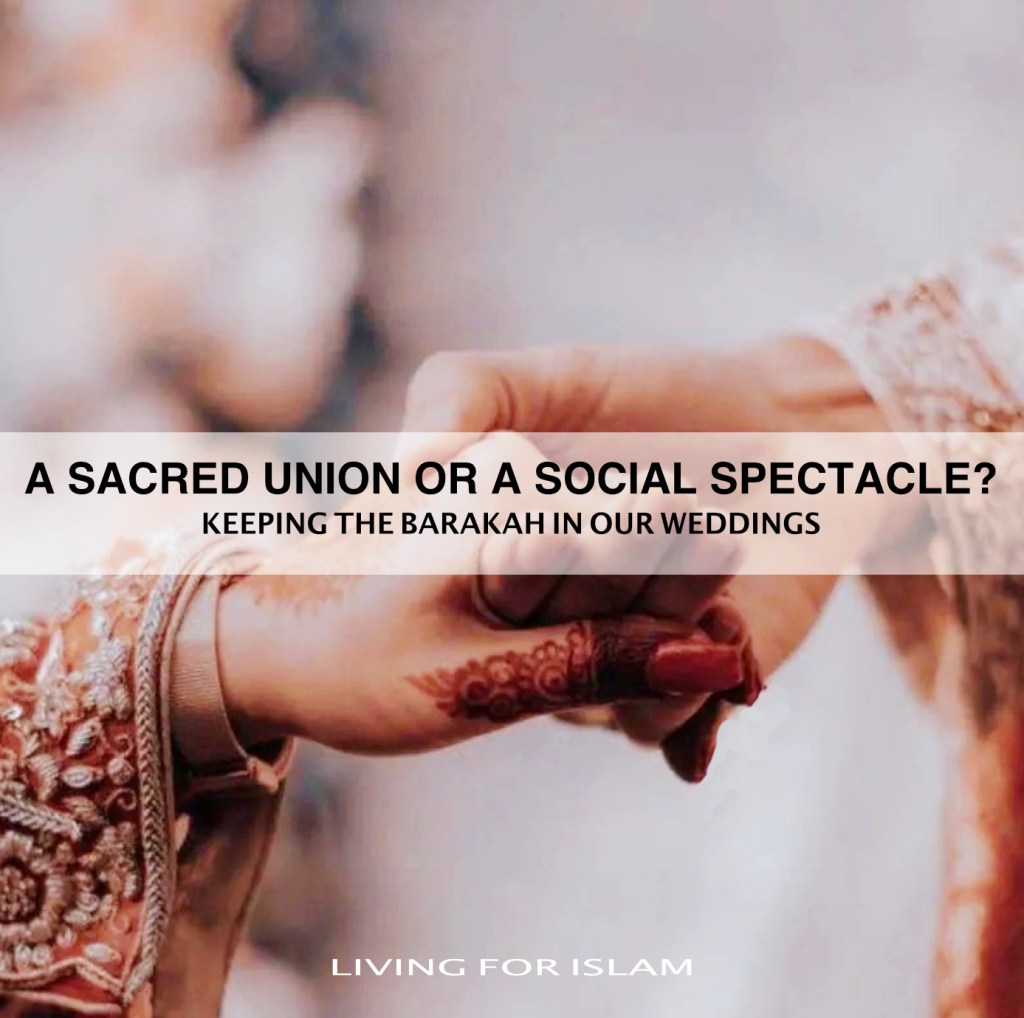
SUMMER USHERS IN the wedding season — a time of joy, blessings, and new beginnings. Yet, for my family and me, invitations to many Muslim weddings have become a source of discomfort. Increasingly, we find these gatherings to be non-segregated, with men and women freely mixing without regard for the boundaries our deen upholds.
As if mixed seating wasn’t concerning enough, we now see trends of choreographed dance routines by friends of the bride and groom, like scenes from a Bollywood movie. These performances are designed to entertain, to dazzle, and, unsurprisingly, to look perfect on Instagram. Some weddings even mimic Christian traditions, where the bride dances with her father in front of the guests before the groom takes the lead.
Frankly, it’s embarrassing.
A wedding in Islam is an act of worship — a celebration of a union that the Messenger ﷺ described as half of one’s deen. Yet many of today’s weddings have the ambience of a nightclub more than a sacred occasion. Worse still, these public displays — often involving immodesty and mixed dancing — are proudly shared on social media without hesitation. All of this happens while people utter bismillah and alhamdulillah, oblivious to the contradiction.
Everyone appears happy, but is Allah pleased? What blessings can we expect from a union that begins with actions that displease the One from whom all barakah comes?
It saddens us to feel excluded. But when a wedding lacks segregation and Islamic guidelines are ignored, we often have no choice but to decline the invitation, even though accepting a Muslim’s invitation is a right they have upon us. The Messenger of Allah ﷺ said: “He who refuses an invitation disobeys Allah and His Messenger.” (Bukhari)
Why Segregation Matters
Our deen sets clear principles to regulate human interaction, especially between men and women. When left unchecked, such interactions can lead to spiritual, emotional, and social harm. This is particularly relevant at weddings, where the bride will be dressed in her finest and is the centre of attention. But that attention must be protected within a space that upholds modesty and safeguards dignity.
Not everyone at such gatherings will have pure intentions. And Shaytan, the ever-present whisperer, exploits these environments. Allah says in the Qur’an:
يَـٰنِسَآءَ ٱلنَّبِىِّ لَسْتُنَّ كَأَحَدٍۢ مِّنَ ٱلنِّسَآءِ ۚ إِنِ ٱتَّقَيْتُنَّ فَلَا تَخْضَعْنَ بِٱلْقَوْلِ فَيَطْمَعَ ٱلَّذِى فِى قَلْبِهِۦ مَرَضٌۭ وَقُلْنَ قَوْلًۭا مَّعْرُوفًۭا
O wives of the Prophet! You are not like any other women: if you are mindful (of Allah), then do not be overly effeminate in speech (with men) or those with sickness in their hearts may be tempted, but speak in a moderate tone. (al-Ahzab 32)
Though this ayah addresses the Prophet’s ﷺ wives, the lesson extends beyond them- a recognition that even seemingly innocent interactions can be misinterpreted or lead to temptation.
Islam promotes segregation not to suppress joy, but to create safe and respectful environments where both men and women can enjoy themselves within the bounds of iman. A review of the seerah and the practices of the Messenger ﷺ and his companions shows this clearly: women would celebrate with the bride in their own space, and men would gather separately.
There were public wedding processions, yes, but upon arrival at the home or venue, men and women would separate. Free mixing at social events was simply not part of the Islamic ethos.
We see this separation in the most basic aspect of the hijab. Conceptually, hijab is more than just clothing. It’s about attitude and conduct. It desexualises. And in doing so, it humanises our experience as men and women. It creates an environment of dignity and respect, allowing men and women to interact productively and spiritually, free from objectification.
Reclaiming Islamic Values
Ironically, even in Western societies, there is growing awareness of the need for gender-segregated spaces in public transportation and events, to make women feel safer. Yet, many Muslims seem to be turning away not only from their Creator but even from common sense and the problems that surround us!
Rather than embodying the timeless solutions Islam offers, we imitate trends from others, even when they lead to harm. The Prophet ﷺ warned us: “You will surely follow the ways of those before you, hand span by hand span, arm’s length by arm’s length, until if they entered a lizard’s hole, you would follow them into it.” (ibn Majah)
This hadith is a stark warning: do not blindly imitate others. Reflect. Question. Discern. If others pursue paths that lead to confusion or spiritual emptiness, should we follow them? Even if they wrap it in the language of fun and modernity?
In closing, weddings are a celebration — but in Islam, they are first and foremost an act of worship. Let us make them a source of joy, beauty, and barakah, not regret. May we strive to uphold the values of modesty, respect, and sincerity — not just in words, but in the way we celebrate life’s most important milestones.
 Living For Islam
One thought on “A Sacred Union or a Social Spectacle?”