
DEMOCRACY HAS LONG been a product of Western political thought. In modern times, it has been marketed as a cure for tyranny, corruption, and extremism.
In the Muslim world—familiar as it is with these afflictions—democracy thus often appears as the solution. But after spending 35 years in Britain, the world’s oldest continuous democracy, and witnessing the system firsthand, I believe these assumptions are deeply flawed. Democracy is neither suited to the Muslim world nor, in any way, to humanity at large.
From early childhood, British citizens are taught the virtues of democracy: participation, free choice, representation, and accountability. They learn how laws are made, take part in student elections, and engage in youth parliaments. But this education is delivered uncritically. Democracy is presented as the best—indeed, the only legitimate—system, without serious analysis of its flaws or historical context. This results in an unquestioning acceptance of secular democratic values, instilled in children before they are old enough to question them.
This uncritical mindset extends beyond the West. In many post-colonial societies, the intelligentsia mimic the Western model, adopting democracy without scrutiny. And when nations or peoples resist this model, Western powers have shown little hesitation in using military force or regime change to impose it, championing democracy at the barrel of a gun.
The Myth of Representation and Accountability
Democracy is praised for its ideals of representation and accountability. But how real are these claims?
Universal representation was never inherent to democratic systems. In the U.S., the Founding Fathers declared all men equal—yet they excluded slaves, women, and the landless poor. It wasn’t until 1965 that Black Americans were guaranteed the right to vote after years of struggle in the Civil Rights Movement. In the UK, women only achieved voting equality in 1928 after a similar Suffragette Movement, and 18-year-olds gained the right to vote in 1970.
Accountability fares no better. We’re told that democracy provides the power to remove leaders via elections, but in practice, this means waiting 4–5 years, during which politicians often break election pledges, act irresponsibly, and serve elite interests. Research, including studies from Princeton University, shows that policymaking is disproportionately influenced by corporations, media moguls, and lobbyists, while the ordinary citizen has minimal sway.
Little wonder, then, that voter apathy and political disillusionment are at record highs across the democratic world. Many see no real difference between political parties—only more of the same. In other words, democracy is dying.
And in a system where laws are made by majority rule, how can minority rights and voices truly be protected?
The Core Flaw: Who Holds Sovereignty?
At its core, democracy is rule by the people—demos (people) and kratia (power). Sovereignty belongs to the people, who choose legislators to enact laws on their behalf.
This is where Islam fundamentally diverges. In Islamic belief, sovereignty belongs to Allah alone. He is al-Hakam, the only legitimate lawgiver.
إِنِ ٱلْحُكْمُ إِلَّا لِلَّهِ
Legislation is not but for Allah. (Yusuf 40)
وَأَنِ ٱحْكُم بَيْنَهُم بِمَآ أَنزَلَ ٱللَّهُ وَلَا تَتَّبِعْ أَهْوَآءَهُمْ وَٱحْذَرْهُمْ أَن يَفْتِنُوكَ عَنۢ بَعْضِ مَآ أَنزَلَ ٱللَّهُ إِلَيْكَ
Judge between them by what Allah has revealed, and do not follow their desires. (al-Ma’idah 49)
This aspect of democracy is deliberately downplayed by the West and the advocates of liberal secularism, knowing it is incompatible with Islam. Yet this core misalignment is perhaps the reason democracy doesn’t work in the Muslim world- we just don’t believe in it.
Islam does not oppose the concepts of representation, accountability, or even voting. These have a place in Islamic governance and were practised during the Khulafah Rashidun. But their foundation lies in revelation, not in human philosophy.
In Islam, Allah is sovereign, while authority belongs to the people. The people give bay‘ah (allegiance) to a ruler who governs by the Qur’an and Sunnah. He consults the people through shura and remains accountable, not to shifting public opinion, but to divine law.
Abu Bakr (ra), in his inaugural speech, succintly summed up: “If I do right, help me. If I do wrong, correct me.” (al-Sīrah al-Nabawiyyah)
Unlike democracy, where laws can be manipulated by special interests, Islam provides a fixed legal framework (Shari’ah), ensuring stability and justice. Accountability is sincere because it’s rooted in taqwa and the Islamic duty of amr bil ma‘ruf wa nahi ‘anil munkar (enjoining good and forbidding wrong) and not personal or national interests.
Why This Matters
For the Ummah, understanding the true nature of democracy—and how it differs from Islamic governance—is essential. Without this clarity, we risk being diverted from our goals and misled into supporting systems that fundamentally oppose Islam.
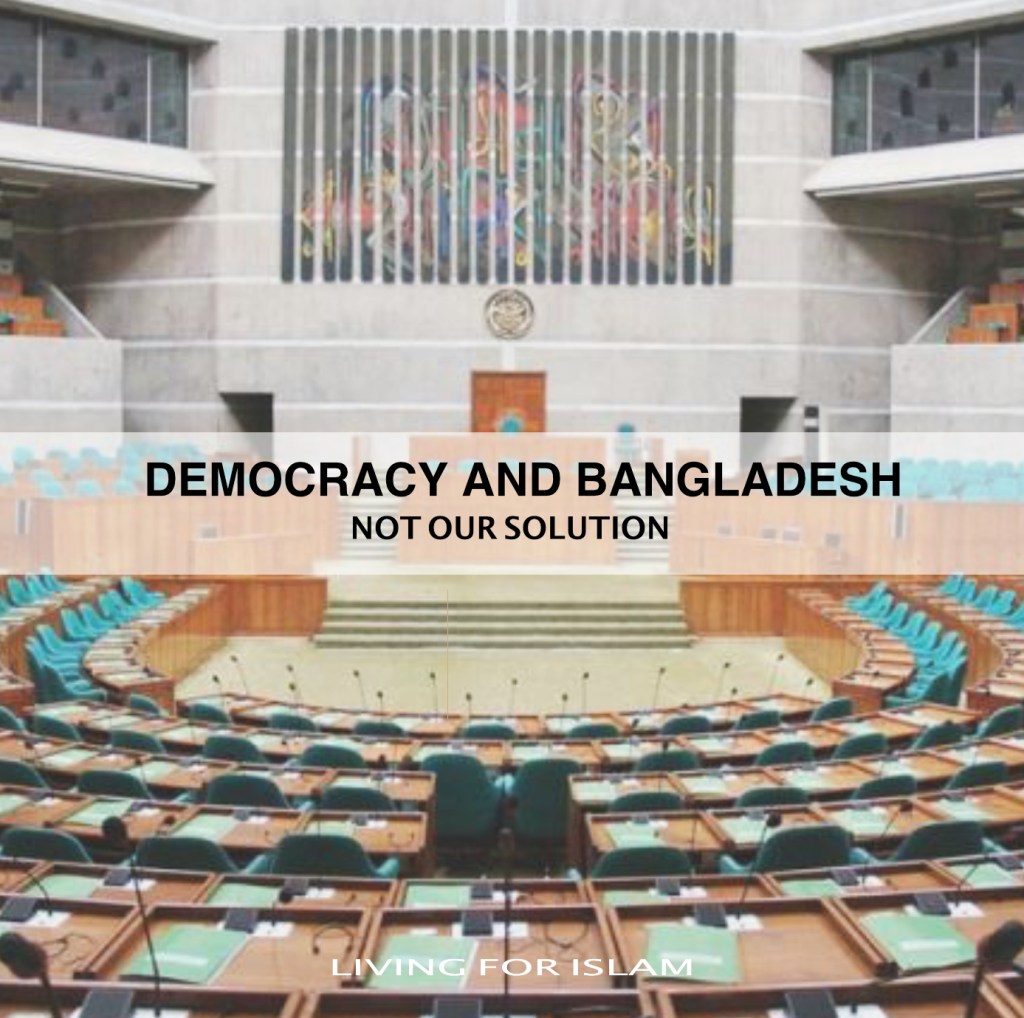
We’ve seen this pattern repeatedly: in Algeria, Egypt, and Turkey, where Islamic parties, even after winning elections, have been prevented from delivering genuine Islamic change. In Bangladesh, alliances between Islamic groups and secular parties like the AL or BNP have yielded little, as the constitution itself enshrines secularism.
Political systems are designed to preserve themselves. When Muslims seek power through such systems, they inevitably compromise. Once you compromise to enter power, you’re likely to do it again to stay in power.
This is why Allah warned His Messenger ﷺ in Makkah:
فَلَا تُطِعِ ٱلْمُكَذِّبِينَ
وَدُّوا۟ لَوْ تُدْهِنُ فَيُدْهِنُونَ
So do not obey the deniers. They wish that you would compromise, so they would compromise.” (Al-Qalam 8–9)
The Islamic Political Vision
Islamic politics affirms the people’s right to choose their ruler, to be represented, to hold leaders accountable, and to live under the rule of law. But these principles must arise from Islam, not secular ideologies.
The Islamic political system, the Khilafah, is based on these values. It was established by the Prophet ﷺ in Madinah after 13 years of struggle in Makkah. It was not created through elections or alliances with un-Islamic systems, but through steadfast adherence to divine guidance and method.
The path to re-establishing Khilafah today must follow the prophetic model, not the democratic process. Muslims must evaluate every idea, system, group, and individual through the lens of Islam, without compromise or confusion.
It is especially concerning when Islamic groups in places like Bangladesh participate in democratic politics. By doing so, they blur the line between Islam and secularism, confuse the masses, and dilute Islam’s message.
وَلَا تَلْبِسُوا۟ ٱلْحَقَّ بِٱلْبَـٰطِلِ وَتَكْتُمُوا۟ ٱلْحَقَّ وَأَنتُمْ تَعْلَمُونَ
“Do not mix truth with falsehood, nor conceal the truth while you know it. (al-Baqarah 42)
Let the Ummah be clear: We believe in accountability, in justice, in representation—but we believe these must be grounded in Islam, not in man-made systems. Only by returning to the Islamic model of governance can we hope to achieve true justice and revival.
 Living For Islam