
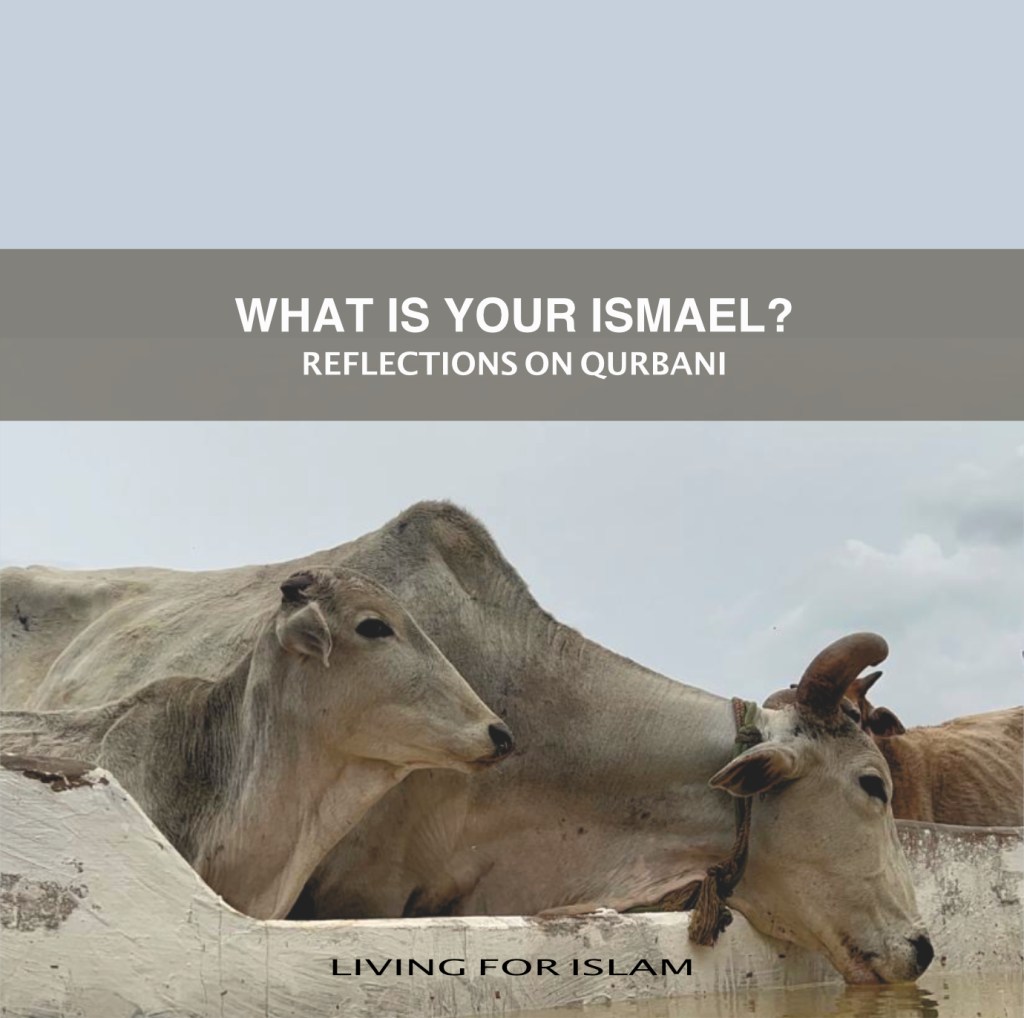
WHEN I WAS a boy, I remember asking my father about Qurbani.
He told me it was about sacrifice — about giving up what you love, for the sake of Allah.
He shared a story from his own childhood, growing up on a village farm in the 1930s and 40s.
While my grandfather was a merchant, often travelling across what was then India to trade, my father and his brothers stayed behind, tending to the family land. My father would care for the cows and buffalos before school and again after he returned. He knew them all by name. He was attached to them — not just as animals, but as living beings he cared for daily.
And yet, once a year, he would be part of the Qurbani — the sacrifice of one of those very animals. It was never easy.
But that, he said, was the point. That’s what it meant to sacrifice.
Qurbani, then, made sense to him. It was lived, not just learned.
But as I grew older, I realised that this view may not resonate in the same way for those of us raised in cities — where our only connection to livestock is through the meat served on our plates.
So we return to the story that underpins it all: the story of Ibrahim (as) and Ismail (as).
A story that demands not just attention, but reflection.
Ibrahim (as) was asked to sacrifice his son — his only son at the time — for the sake of Allah. The son who, just a few years earlier, he had been ordered to leave with Hajar in the middle of a barren desert. At a time when sons were your strength, pride and legacy in a harsh and unpredictable world.
And now, he was seeing the dream — again and again — commanding him to take that same son and offer him in sacrifice.
The dreams of prophets are revelation. So he knew it was a command.
We can only imagine the weight of that moment. The conflict in his heart. The struggle of a father.
Yet Ibrahim (as) obeyed. He submitted.
And Ismail (as), too — a boy old enough to understand, yet pure enough to submit — said: “O my father, do as you are commanded. You will find me, if Allah wills, of the steadfast.”
And so the Qur’an tells us:
فَلَمَّاۤ اَسۡلَمَا وَتَلَّهٗ لِلۡجَبِينِ
And when they had both submitted and he laid him down on his forehead. (as-Saffaat 103)
This is the meaning of Islam — submission.
It begins with the recognition that Allah is the Creator of all things. That we are weak and needy, while He is Mighty and Self-Sufficient. That we are slaves, and He is our Master — deserving of absolute obedience.
Of course, the purpose of this test was never to harm Ismael. But to remind Ibrahim (as) to always love the Giver of the gift more than the gift itself.
It is this act of submission that believers honour every year during Eid al-Adha.
But if we walk away from that day having only spent money, spilled blood, and shared meat — without reflecting on the deeper meaning — we’ve missed the point.
Every day, we already make sacrifices — for our careers, our families, our ambitions, our comforts.
But the story of Ibrahim (as) asks us: What are you willing to sacrifice for Allah?
Each of us has an Ismail — something we love, something that may be holding us back from complete surrender to Allah.
For some, it’s wealth or status. For others, it’s relationships, pastimes, or desires. Sometimes it’s fear — of people, of failure, of missing out. Sometimes it’s laziness, distraction, or doubt.
Whatever it is, it must be brought to the altar — and sacrificed for His sake.
Yes, it’s hard. It takes honesty, struggle, and faith. But that’s what submission means. That’s what brings reward.
And today, that call to sacrifice feels even more urgent.
As we witness the unrelenting suffering of our brothers and sisters in Palestine — 600 days of genocide, while the world turns its back — we must ask ourselves: What are we willing to sacrifice to bring about change?
Our time? Our money? Our comfort? Our career?
Allah is testing us.
Will we respond like Ibrahim (as)? Or will we turn away?
 Living For Islam