
WE ARE IN the most sacred days of the Islamic calendar—the days of Dhul Hijjah, days in which righteous deeds are more beloved to Allah than any other time of the year.
But whilst we strive to accumulate our good deeds in these sacred days, are we missing something deeper. A lesson… a reminder… and a reality that many of us experience every year—the unity of the Ummah, and the challenges that stand in its way.
The Governor of Makkah, once said: “The Messenger of Allah ﷺ took a pledge from us that we should perform the rites of Hajj after sighting the moon. If we do not see it, and two reliable persons bear witness, we should perform the rites based on their testimony.” (Abu Dawud)
This tells us something profound: The beginning of Dhul Hijjah is based on the moon sighting of Makkah, or the sighting accepted from other trustworthy sources.
So what are the scenarios?
- If Makkah sees the moon—then everyone follows that.
- If they don’t, but others do—they are to accept those reports.
- If no one sees the moon—then 30 days of Dhul Qa’dah are completed, and Hajj proceeds accordingly.
Simple, right? Clear. Unified.
But then comes the problem…
Nationalism.
Today, countries treat moon sightings like a matter of sovereignty. Saudi Arabia doesn’t accept moon sightings from Muslims outside its borders. And many Muslims around the world refuse to follow the sighting of Makkah or elsewhere.
So what happens?
We begin Dhul Hijjah on different days.
We fast Arafah on different days.
We celebrate Eid on different days.
And this… for the most unifying event in Islam—Hajj! An act where millions gather in one place, at one time, for one purpose: to seek Allah’s pleasure.
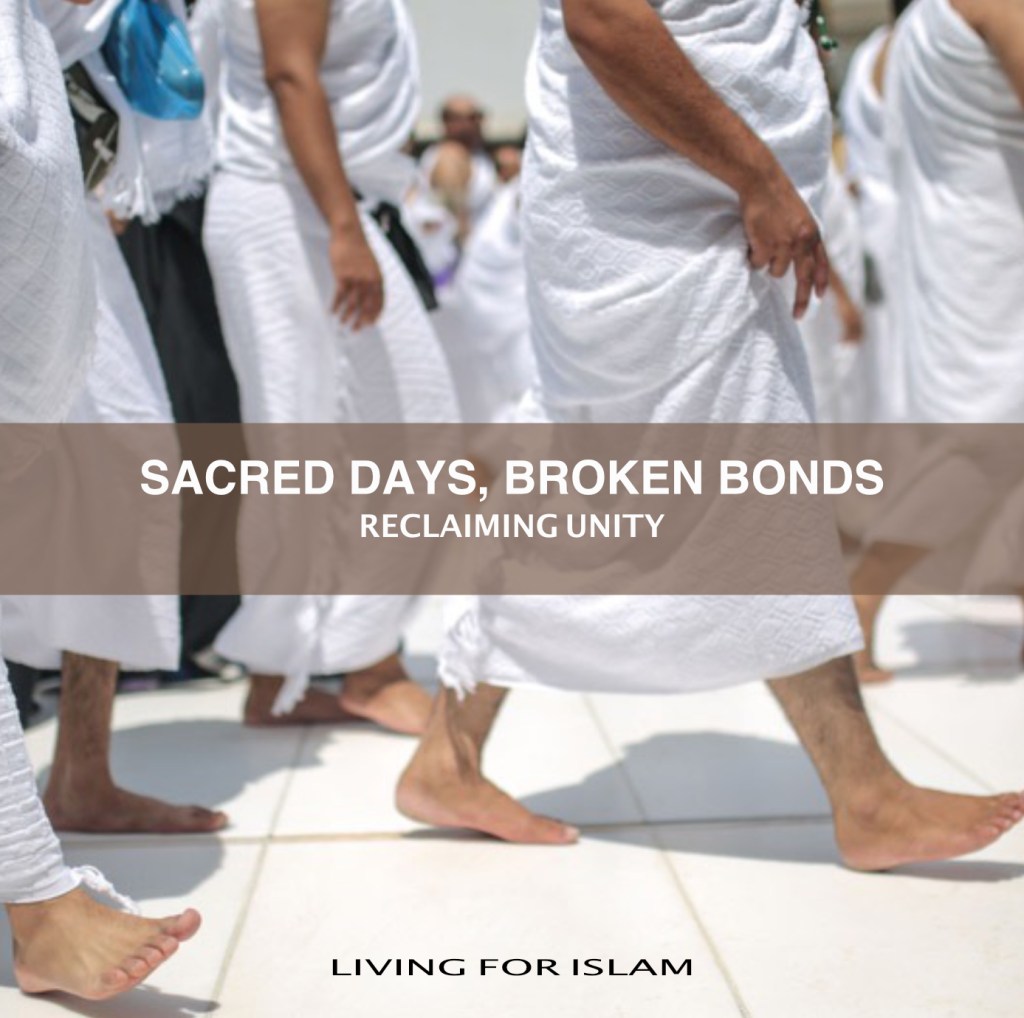
Hajj is one of the greatest signs of our unity. Different colours. Different languages. Different cultures. All wearing the same clothes. All reciting the same words. All answering the same call: Labbayk Allahumma Labbayk.
But then, nationalism puts up walls.
We know the reward of those who perform the Hajj. But Allah is most Generous with His reward and those who cannot go are not left out. There are many good actions that we can perform. We can fast on the day of Arafah through which Allah forgives the sins of the year before and the year to come, if He wills. But to fast that day is also a sign of solidarity with our ummah who are standing on the plain on Arafah- a single ummah engaged in the worship of their Lord on a single day. In the past, we find different scholars, including the companion Ibn Abbas (ra), would assemble in the masajid in solidarity with their pilgrim brothers and sisters on the Day of Arafah. Qadi Ibn Al-Arabi explains: ‘People of different areas are followers to the pilgrims in this issue” (Al-Arabi, Ahkamul Quran, Vol. 1, P. 143)
Because it’s not just about seeing the moon. It’s about seeing the bigger picture—that we are one body. One community. One Ummah.
Of course, the hujjaj in Saudi have no alternative but to stick to the Saudi dates out of practicality. But we keep seeing how the disease of nationalism causes such problems and as we enter these most sacred of days we need to be striving, amongst all the other good deeds, for true Muslim political unity. The fruits of its absence are clear for all to see.
وَٱعْتَصِمُوا۟ بِحَبْلِ ٱللَّهِ جَمِيعًا وَلَا تَفَرَّقُوا۟
And hold firmly to the rope of Allah and do not be divided.’ (ale-Imran 103)
 Living For Islam