
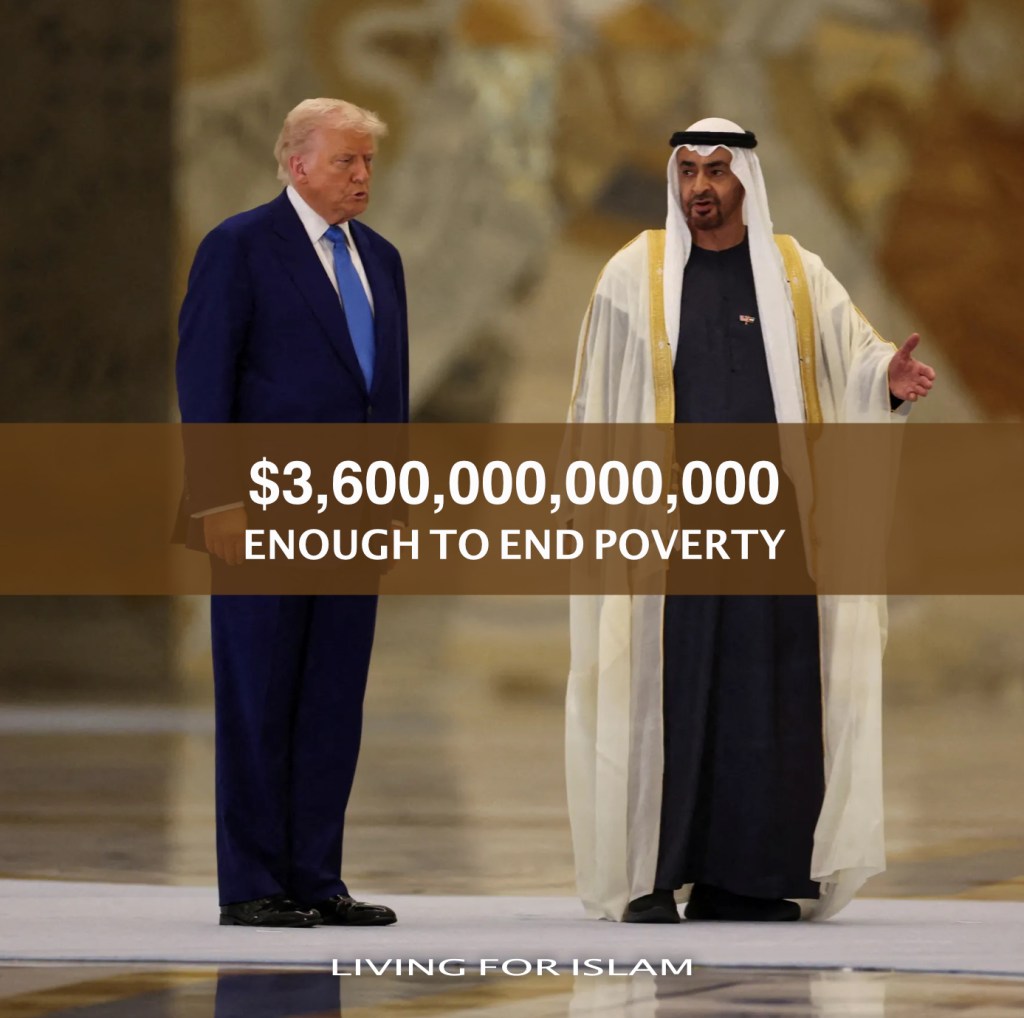
DURING THE HIGH-profile visit to the Middle East, U.S. President Donald Trump announced a staggering $3.6 trillion in investment agreements with Saudi Arabia, Qatar, and the United Arab Emirates. These deals, spanning sectors like defence, aviation, and artificial intelligence, were sealed alongside lavish banquets and business showcases. Dozens of American business leaders accompanied him, eager to secure their share.
But beyond the diplomatic photo ops and billion-dollar smiles lies a darker truth.
He Came. He Took. They Gave.
Each ruler competed to outdo the other: offering more, conceding further, and paying what can only be described as protection money. They recognized the cost of keeping power while facing their people’s resentment and the Muslim world’s quest for alternatives. And so they gave without question, through grinning teeth.
It was painful to watch. A display of subservience dressed as diplomacy. And all at the ummah’s expense as our wealth is squandered away.
This is the raw, unfiltered face of capitalism: transactional, amoral, and ultimately self-serving. Trump, who doesn’t like Islam and Muslims, had no qualms about signing billion-dollar deals with Muslim rulers. They, in turn, welcomed him warmly, despite his record of moving the Zionist embassy to Jerusalem, cutting aid to Palestinian refugees, and enabling the ongoing genocide in Gaza.
An Unimaginable Sum
$3.6 trillion. It’s a figure so large it’s difficult to wrap the mind around. To put it in perspective, global estimates suggest that eradicating poverty, lifting over 2 billion people out of extreme and absolute poverty, would cost between $70 billion and $325 billion per year.
In other words, with this amount of money, we could have effectively ended global poverty for the next 10 to 50 years.
Instead, the money will line the pockets of billionaires. It will build more weapons, inflate tech empires, and reinforce a system where the rich grow richer, while the poor get poorer.
This is capitalism by design. It is not a system of equity, but one of extraction. It concentrates wealth and power in the hands of a few, and it creates a world where suffering for huge numbers of people is a byproduct of profit.
What’s worse is that it creates systems that maintain these extremes. The rich become blinded by their wealth and have no incentive to work to change the system from which they benefit. Meanwhile, the poor are struggling to survive and lack the time or resources to effect change.
This is exactly what we see created in the Muslim world- the extremes of richness in the Gulf states and poverty elsewhere.
Islam: A System Rooted in Justice
Islam offers a fundamentally different vision of society.
Ali ibn Abi Talib (ra) once said: “If poverty were a man, I would have slain him.” Islam recognizes poverty not just as a financial state, but as a humiliating condition that can corrupt a person’s soul and weaken their faith. It causes immense psychological stress, and in many cases, it drives people to lie, steal, or beg, actions that Islam seeks to eliminate.
The Messenger ﷺ frequently sought refuge from poverty. For example, he prayed: “O Allah, I seek refuge with You from want, poverty and humiliation, and I seek refuge with You from wronging others or being wronged” (Nasa’i)
Islam defines poverty simply: as the inability to meet one’s basic needs—food, clothing, and shelter based on the Prophet ﷺ saying: “There is no right for the son of Adam other than these things: a house in which he lives, a garment to cover his nakedness, a piece of bread, and water.” (Tirmidhī)
In another profound hadith, he ﷺ said: “Whoever among you wakes up secure in his property, healthy in his body, and has his food for the day—it is as if he were given the entire world.” (Tirmidhi)
This hadith is a powerful reminder: wealth is not in material excess but in having enough. A roof over our heads, health, and food on the table are among the greatest blessings of this world. Gratitude for these blessings brings even more, both spiritually and materially.
But Islam doesn’t stop at the individual. It urges us to look beyond ourselves. The Prophet ﷺ said: “None of you truly believes until he loves for his brother what he loves for himself.” (Muslim)
This is not a feel-good saying, it is a call to action. How can we rest while our brothers and sisters in Gaza are bombed out of their homes, and deprived of food, water, and medical care? How can we claim to love others as ourselves while two billion around the world live in desperate poverty?
A Comprehensive System for Humanity
Islam is not just a personal faith, it is a comprehensive system. Its teachings span personal conduct, community responsibilities, and societal structure. The goal is a just and equitable world where every individual’s basic needs are met, not through charity alone, but through structural justice.
So many of the Qur’anic verses and Prophetic traditions operate on multiple levels- individual, communal, and societal. Islam was never meant to be reduced to a private affair of rituals and worship. It came to liberate, to elevate, and to establish justice.
We must resist the temptation to internalize an individualistic version of Islam. The Prophet ﷺ warned of a time when Muslims would be like froth on the sea, many in number but lacking strength. That time is upon us.
To change this, we must reconnect with Islam’s complete vision. We must strive for a system that ensures security, dignity, and opportunity for all. Not just for ourselves, but for our neighbours, our communities, and humanity as a whole.
Conclusion
Trump and our leaders act like they own the world. Muslims need to realize that we all share this world and must work to reestablish the alternative that Islam provides. This path is based on justice, compassion, and fairness.
“Whoever wakes up with security, health, and food for the day, it is as if he owns the world.”
Let us work to make sure that becomes the reality for everyone in the world.
 Living For Islam