

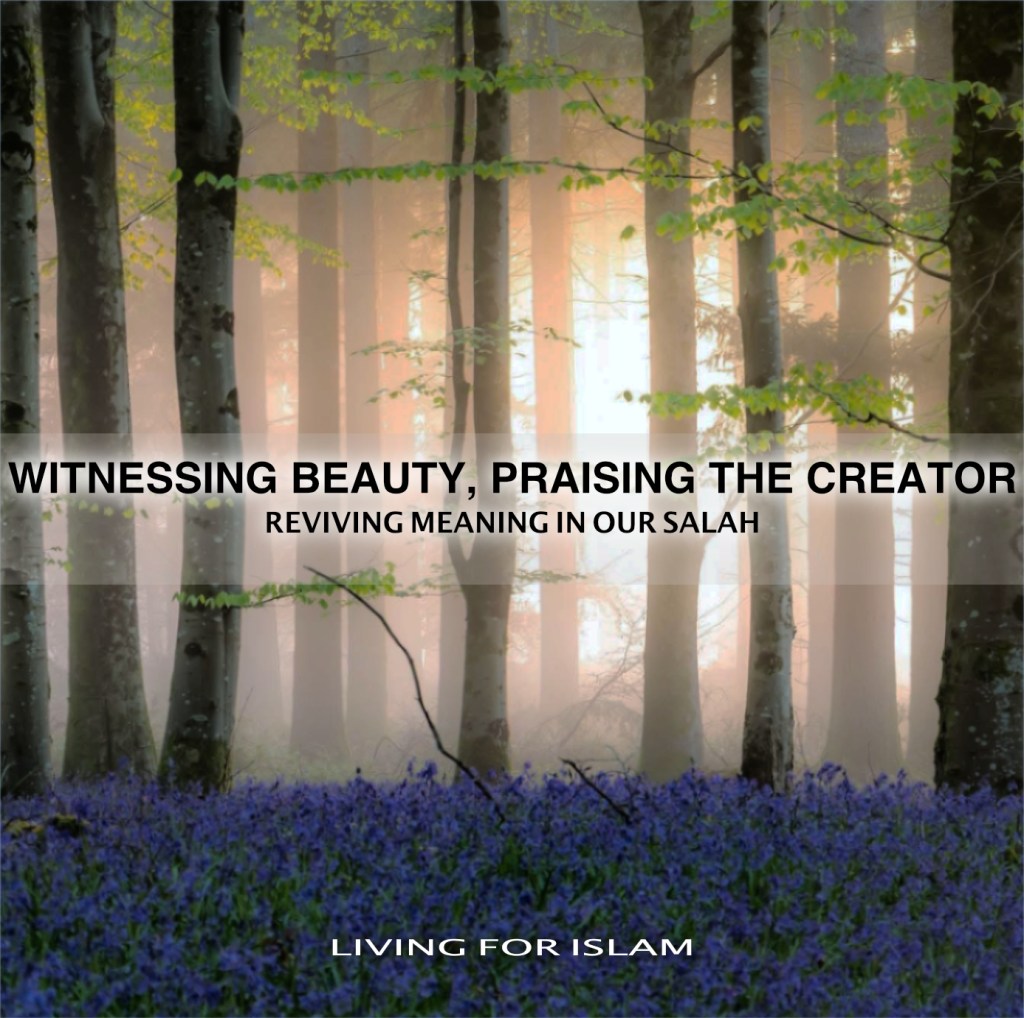
IT IS SPRING. Everywhere you look, the world has come alive — a riot of colour unfurling in every direction. The pale blue of forget-me-nots and bluebells, the soft pinks and pure whites of apple blossoms, the bold red of photinia, the fiery orange of young maple leaves, the deep purple of lilacs, the vivid splendour of tulips — and all around, an endless sea of greens as the leaves awaken from their sleep.
It is a breathtaking sight. Each plant is a little different. Each blossom is a little unique. Each day is a little more wondrous than the one before.
Subhan Allah. Perfect is Allah.
Alhamdulillah. All praise belongs to Allah, Who allows us to witness such beauty from His boundless mercy.
These glimpses — these ayat, these sacred signs woven into creation — whisper to our hearts, calling us back to Him.
Yet they are not just moments to admire and pass by. They are meant to anchor us more deeply in our lives of worship — especially in our salah.
When we rise from bowing, we say: ‘Sami Allahu liman hamidah.’ Allah hears the one who praises Him.
But how often do we pause at that moment? How often do we fill it with real meaning, with a heart overflowing with praise?
It is here that the quiet reflections of the day — the beauty seen, the blessings felt, the mercies known — should burst forth, unbidden, into words of sincere gratitude. Not mechanical. Not rushed. But living, breathing praise rising from the depths of the soul.
Salah is not a routine. It is a conversation — a sacred meeting — with our Lord.
Listen to this moment from the life of the Prophet ﷺ: “We were once praying behind the Prophet ﷺ. When he raised his head from bowing, he said: ‘Sami Allahu liman hamidah.’ A man behind him responded: ‘Rabbana wa laka l-hamdu, hamdan kathiran tayyiban mubarakan fihi (O our Lord! All praise is for You — abundant, pure, and blessed).’ When the Prophet ﷺ completed the prayer, he asked: ‘Who spoke those words?’ The man replied: ‘I did.’ The Prophet ﷺ said: ‘I saw over thirty angels racing to record it first.'” (Bukhari)
It was a spontaneous moment — genuine, alive. The man praised Allah with a heart that felt the meaning of what he said. And Allah honoured it.
The salah has a structure, yes — taught and exemplified by the Prophet ﷺ — but within it, there is a sacred space for the heart to pour itself out before its Maker.
Look also at another glimpse into the Prophet’s ﷺ prayer: “Anas used to show us how the Prophet ﷺ prayed. When he raised his head from bowing, he would stand so long that we would think he had forgotten to prostrate.” (Bukhari)
Why? Because he was standing in real praise. He was lingering in the beauty of that moment — lost in the nearness of Allah.
If we are disconnected from the signs around us, blind to the countless mercies showered upon us, then our words in prayer will be few and hollow. But if our hearts are alive — if we are witnesses to His blessings in every breath, every colour, every heartbeat — then even a simple Alhamdulillah will burst forth from a place so deep, it will carry the weight of all we have seen and felt.
And so, our praises in salah will not be the same each time. They will change, from rak’ah to rak’ah, from prayer to prayer, from day to day — as life itself constantly reveals new reasons to love, to praise, to thank.
ٱلْحَمْدُ لِلَّهِ ٱلَّذِى لَهُۥ مَا فِى ٱلسَّمَـٰوَٰتِ وَمَا فِى ٱلْأَرْضِ وَلَهُ ٱلْحَمْدُ فِى ٱلْـَٔاخِرَةِ ۚ وَهُوَ ٱلْحَكِيمُ ٱلْخَبِيرُ
All praise belongs to Allah, to Whom belongs all that is in the heavens and the earth; and all praise will be His in the Hereafter. And He is the All-Wise, the All-Aware. (as-Saba 1)
 Living For Islam