
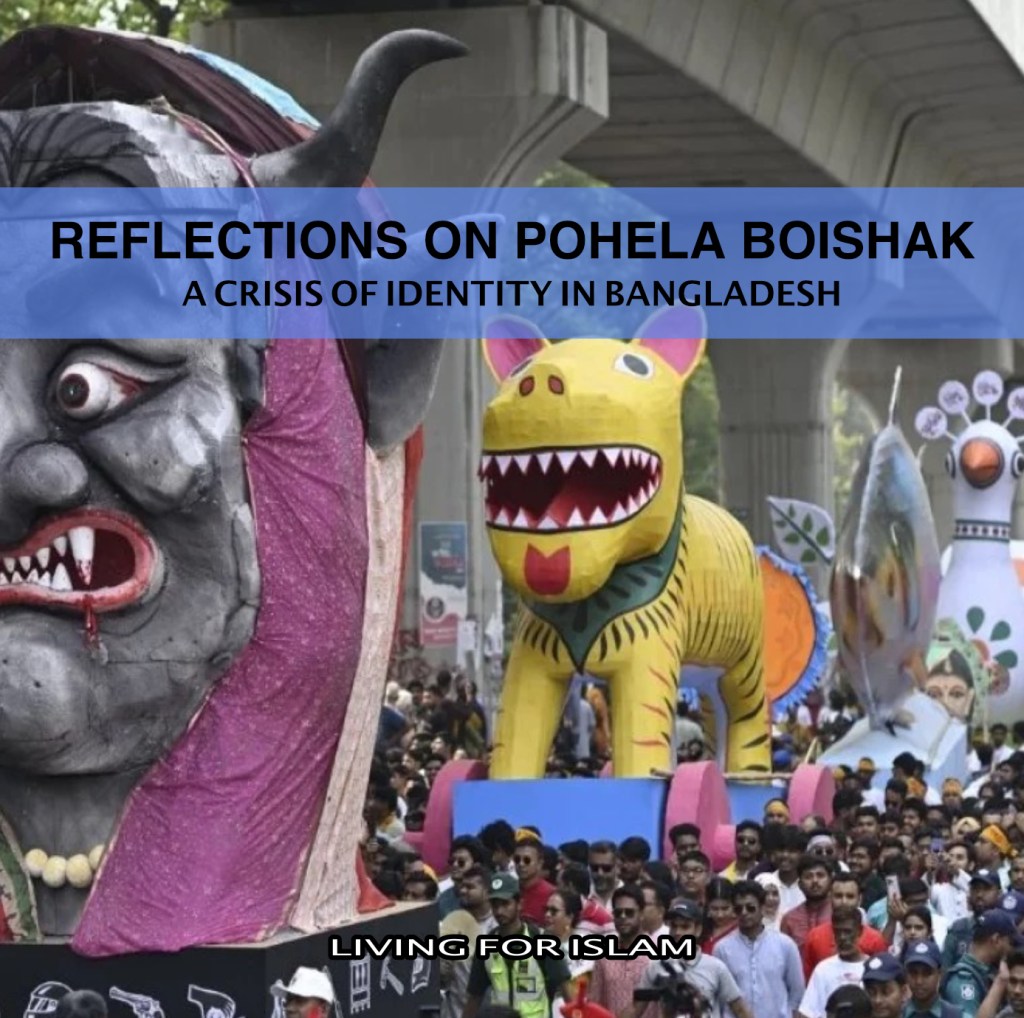
OBSERVING YESTERDAY’S POHELA Boishakh (Bengali New Year) celebrations in Bangladesh, it became increasingly clear that the country is struggling with an identity crisis. On one hand, there’s a secular wave pushing for a revival of pre-Islamic Bengali traditions. On the other, there’s a call from many Muslims to uphold Islamic values in public and private life.
Those who come from an Islamic background have been vocal in reminding others that participating in such festivities- with elements of free mixing, idols, and cultural performances- is haram. They cite the hadith: “The Messenger of Allah ﷺ came to Madinah and found the people celebrating two days. He asked, ‘What are these two days?’ They replied, ‘We used to celebrate them during the days of ignorance (Jahiliyyah).’ The Prophet ﷺ said, ‘Indeed, Allah has replaced them with two better days: Eid al-Adha and Eid al-Fitr.'” (Abu Dawud)
And he ﷺ also said: “Whoever imitates a people is one of them.” (Abu Dawud)
These are powerful reminders, but to stop there is to miss a critical opportunity—to foster love for Islam and to counter the secular narrative that Islam is rigid, intolerant, and incompatible with culture and artistic expression.
Islam as a Comprehensive Way of Life
It is strange that in a country where the majority are Muslim, the Islamic identity is increasingly sidelined in favor of an older, pre-Islamic Bengali identity. I don’t recall seeing Pohela Boishakh processions or rallies when I lived in Dhaka in the 1980s and 1990s. The rise of such celebrations was especially pushed during the Hasina administration and seems to align with a broader Western narrative post-9/11- one that seeks to dilute Islamic influence under the guise of cultural identity.
But let’s examine this so-called Bengali identity. What does it really offer? A language- shared with West Bengalis, who arguably speak it with more finesse. Some cuisine, some clothing. But beyond that?
Does it guide you on how to raise a child, conduct a marriage, or mourn the dead? Does it offer a system of economics, justice, or governance? Does it answer life’s fundamental questions—where we came from, our purpose, and what lies beyond death?
This identity, on its own, lacks substance. And because it fails to provide a complete worldview, we borrow bits and pieces from elsewhere to fill the void. The result is a patchwork of conflicting ideologies- Western, Eastern, Islamic, non-Islamic- all pulling us in different directions. This internal confusion breeds instability, both individually and as a society. It hinders true progress and makes us vulnerable to manipulation- by both local elites and foreign powers.
Now compare that with the Islamic identity.
It answers every essential question- from our origin to our purpose and destiny. It defines our relationship with the Creator, with ourselves, and with others. It governs our economy, legal system, societal roles, and personal conduct. It is a unified system, flowing from a single divine source, bringing harmony to the individual and to society. It gives a cohesive and empowering identity- one that once drove Muslims to take Islam to the ends of the earth.
And importantly, Islamic identity isn’t bound by race or geography. Anyone can embrace it. It unites people as equals- without hierarchy of ethnicity or nationality.
The Many Labels We Carry
We all carry multiple identities- and that’s a reality we can’t deny. I’m Bangladeshi by birth, with parents who also hail from Bangladesh. That makes me South Asian. I also hold British citizenship, which ties me to Europe. I’m a man, a professional, a husband, a father. These labels are part of who I am.
But it is Islam that gives these identities meaning and order. It helps us understand which ones are primary, which ones are circumstantial, and how they all fit within a higher purpose. Islam offers the lens through which we can navigate these layers without confusion or contradiction.
There’s nothing inherently wrong with speaking Bengali, enjoying rice and hilsa, or wearing a lungi. These elements of culture are not just tolerated; they’re permissible because Islam allows for cultural expression within the boundaries set by the Creator.
However, not everything that is cultural is automatically acceptable. But what about free mixing, idol-making, public dancing, and immodest dress? These are not neutral cultural expressions—they are tied to values that contradict Islamic teachings.
Culture Is a Manifestation of Belief
What we often label as “culture” is not value-neutral—it is a reflection of underlying beliefs.
In the Muslim world- from the Atlantic coast of Africa to the Pacific coast of Indonesia- we find immense diversity. But beneath the surface of varied cuisines, clothing, and languages lies simple guiding principles:
- Food must be halal.
- Clothing must be modest and cover the ‘awrah.
- Language must reflect truth and decency.
- Architecture reflects values of privacy and community.
Islam has fostered a global culture- unified in its essence, diverse in its expression. No other civilization has achieved this balance.
Contrast that with Western liberal culture, which is founded on the idea that man is sovereign and free from divine authority. It champions absolute individual freedom- leading to unrestrained dress, permissive language, hedonistic lifestyles, and a consumerist, often exploitative society.
Wherever this culture has spread, it has bred division, racial tensions, and moral confusion. In places like the West and India, this has fueled xenophobia and disunity. Rather than creating tolerance, it has deepened intolerance.
Recognizing What Is and Isn’t Ours
Allah reminds us:
يَـٰٓأَيُّهَا ٱلنَّاسُ إِنَّا خَلَقْنَـٰكُم مِّن ذَكَرٍ وَأُنثَىٰ وَجَعَلْنَـٰكُمْ شُعُوبًا وَقَبَآئِلَ لِتَعَارَفُوٓا۟ ۚ إِنَّ أَكْرَمَكُمْ عِندَ ٱللَّهِ أَتْقَىٰكُمْ ۚ إِنَّ ٱللَّهَ عَلِيمٌ خَبِيرٌ
“O mankind, indeed We have created you from male and female and made you peoples and tribes that you may know one another. Indeed, the most noble of you in the sight of Allah is the most righteous of you. Indeed, Allah is Knowing and Acquainted.” (al-Hujurat 13)
Islam does not erase identity- it refines it. It gives it purpose. It unifies without erasing diversity. And in a time of global crisis, confusion, and cultural distortion, it offers clarity, peace, and direction.
Let’s reclaim that.
 Living For Islam
One thought on “Reflections on Pohela Boishakh: A Crisis of Identity in Bangladesh”