
UMAR AL KHATTAB (ra) was a great judge of character and chose the best leaders during his Khilafah. He was thus very surprised when the people of Homs (now in Syria) came to him with four complaints about their governor, Sa’id ibn Amr, whom he had appointed.
Sa’id was recalled from Homs to explain himself because Islam requires fairness and honesty.
The first complaint: ‘He only comes out to attend to people when the sun is already high.’
Sa’id (ra) was too shy to speak and had to be pressed by Umar (ra). Finally: ‘By Allah! I am not inclined towards saying this but it seems it must be said. My family does not have a house help so I get up every morning to mix the flour for our breakfast. I wait for a little until the flour rises and then bake bread for the family. It is only after this that I make wudu and then move out to attend to the people.’
The second complaint: ‘He does not answer any night calls. He leaves all affairs till the next morning.’
To this, Sa’id (ra) reluctantly said: ‘By Allah, I really would not like to disclose this. The truth is that I have left the day for the people and the night for our Lord and Creator, Allah ﷻ .’
The third complaint: ‘For one whole day every month he would not come out at all to meet the people.’
Sa’id’s response: ‘O Amir-ul Muminin, I do not have any other clothes except what I am wearing. I wash this every month, waiting for it to dry before going out later part of the day to attend to the needs of the people.’
The fourth complaint: ‘He faints and loses consciousness at the state meetings.’
The response: ‘I was a witness to the public execution of Khubaib bin Adiy (ra) in Makkah before I embraced Islam. I saw the Quraish cutting him into pieces alive in revenge for their defeat at Badr. As they tore him to pieces they would jeer and insult him: ‘Would you not like Muhammad to be in your place now?’ Khubayb (ra) would say: ‘I would not wish to be safe and secure among my own family while a thorn hurts Muhammad ﷺ.’ By Allah! Any time I remember that day and my failure to come to his rescue, I would be gripped with the fear of Allah’s punishment for this negligence of mine and then lose consciousness.’
There are so many lessons to reflect on. For instance, listening to both sides of a complaint before judging. Hiding our good deeds from the people to prevent showing off. Selflessness and leading a simple life. Incorruptibility by position. Responsibility to others. Having a balance between all our activities.
It is the last complaint that I want to pause on, due to its relevance to this time.
An innocent man was killed in front of Sa’id before he became Muslim. He was young, but he recognized the grave injustice. This event started him on his journey to Islam and haunted him for life.
‘By Allah! Any time I remember that day and my failure to come to his rescue, I would be gripped with the fear of Allah’s punishment for this negligence of mine and then lose consciousness.’ How would he answer to Allah ﷻ that he had witnessed such evil and just stood by amongst the crowds without uttering a word or lifting a finger?
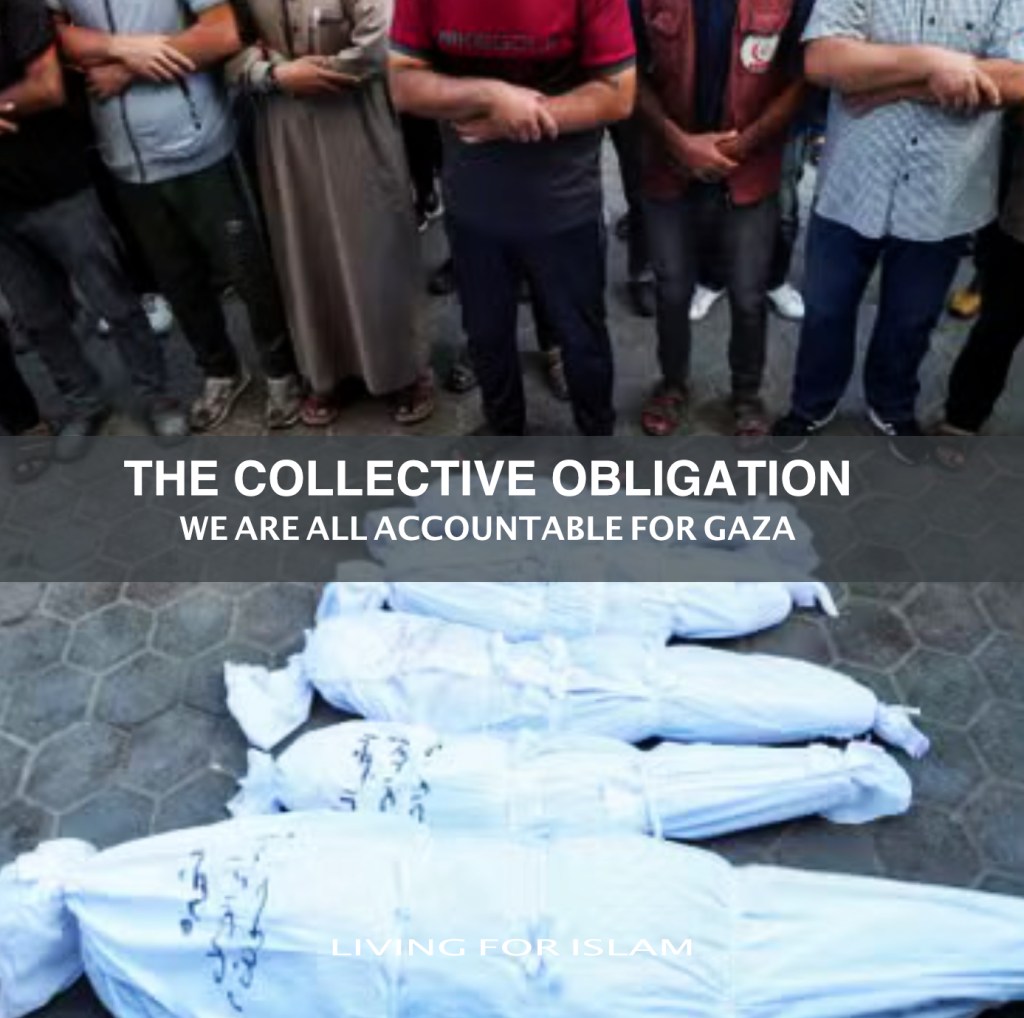
For 18 months we have all been witnessing in real-time the murder and mutilation in the most horrific ways of not one Khubayb but thousands in the ongoing genocide in Gaza.
Is it affecting us the way it should? Can we sleep at night? Can we go about doing what we always do in the same way as before?
As I focus on sin and forgiveness in this last third of Ramadhan, I seek forgiveness for individual sins but more than ever before I fear for the collective sins.
In islam we have a concept of fard ayn and fard kifayah. The fard ayn are the individual obligations. Each will be rewarded for performing it, or punished for failing to perform it. The obligatory prayers, fasting in Ramadhan, zakat, Hajj, obedience to parents, seeking knowledge of those matters that we conduct in our lives, striving to learn the rules of tajweed to be able to recite Qur’an, etc are all examples.
But Islam is a deen of ‘we’ and not just ‘I’. The Messenger of Allah ﷺ said: “The relationship of the believer with another believer is like (the bricks of) a building: each strengthens the other,” and he ﷺ illustrated this by interlacing the fingers of both his hands. (Bukhari)
There are collective obligations that are necessary for the well-being and safety of the Muslim community as a whole, both religious and worldly. Provided it is carried out by some of the Muslim community so that the task is accomplished, then other Muslims do not have to perform it. But if nobody performs the act on behalf of the community, or those that do are unable to fulfil the obligation, then all Muslims are accountable and will be punished by Allah.
Examples are many and far-reaching. The Janazah prayer and having the facilities to bury our dead is an example of fard kifayah. As long as there are some Muslims who pray Janazah of the deceased and ensure the correct burial then the sin is lifted over the whole. Ensuring we have a place of prayer, institutes to teach our children, nikah can be conducted, ulema who can do ijtihad to give rulings on our issues and questions, organising moon sighting, armies to do jihad fi-sabeel-Allah to protect the oppressed, having a group(s) who will give dawah to non-Muslims, having doctors, nurses, midwives, judges and engineers who can provide for the needs of the ummah are other examples.
Most of these would normally be organised by the Khilafah state and we have seen this in our long Islamic history. But with colonialism and the destruction of the Khilafah state, we only have remnants of these functions in our lands whilst the diaspora living in the West/non-Muslim world are having to organise these functions themselves.
Ensuring the presence of this Khailafah state which protects, implements and propagates the deen is perhaps the greatest collective obligation that is missing today. The lack of unitary leadership based wholly on Islam, where the authority and security are in the hands of the Muslims, as established by our Beloved ﷺ in Madinah and continued by the Khulafah after him is having devastating consequences.
For 18 months we have witnessed the genocide. We have not been able to stop it one iota. An ummah of 2 billion, with all its wealth and ability is unable to get a bottle of water into Gaza. As a collective, we have certainly failed. What will we say on the Day of Standing when we meet Allah?
The Gazans have already said that they will hold everyone to account on the Last Day in front of Allah- those who perpetrated and supported this genocide and the Muslims who did nothing to stop it!
We all would agree that our current rulers are one of the major obstacles to the liberation of Palestine (and the other hot spots across the Muslim world). They are the real defenders of the Zionists and stand against Islam and the Muslims. They squander our wealth and hold back our armies from liberating Palestine. We all agree that if we had a righteous ruler and authority and power for Islam we could move to stop this genocide and liberate Palestine.
If we think and say that, then why are we not acting upon it? Why are we letting them betray us time and time again? Why do we let our armies sit in their barracks and not respond to the oppression? Why do we tolerate other than Islam to rule us? Why are we silent?
We say in every salah:
إِيَّاكَ نَعْبُدُ وَإِيَّاكَ نَسْتَعِينُ
You (alone) we worship and You (alone) we ask for help. (al-Fatihah 5)
But do we do so really? Do we worship Allah alone or do we worship the new idols of today, the ideas of secularism, nationalism, materialism, democracy etc. Do we ask Allah for help, turning to His guidance alone, or do we run to our parliamentarians, the comrades on the liberal Left, the UN, the ICJ and the ICC to save us?
In every salah we also say:
صِرَٰطَ ٱلَّذِينَ أَنْعَمْتَ عَلَيْهِمْ غَيْرِ ٱلْمَغْضُوبِ عَلَيْهِمْ وَلَا ٱلضَّآلِّينَ
the Path of those You have favoured—not those You are angry with, or those who are astray. (al-Fatihah 7)
‘Those You are angry with’ refers to the Yahud and ‘those who are astray’ to the Nasara. But what is their characteristic that has led to this? The Yahud had knowledge but failed to act on that leading to Allah’s anger. The Nasara acted but without knowledge leading them astray.
Are these not the characteristics that we see in ourselves today? Our scholars have the knowledge but sit silent only calling to boycott, dua and charity. Our activists rush to action, driven by emotion but without the knowledge of Islam, calling towards every option but the Islamic one.
When a Khalifah dies or is unable to fulfil his role, it is the collective obligation that the next Khalifah is selected within 3 days as per the explicit words of Umar al Khattab (ra) on his deathbed: “When I die, consult for three days, and let Suhaib lead the Muslims in prayer. Do not let the fourth day come without having an Ameer upon you.” (At-Tabaqat by Ibn Sa’d, 3/364)
It has been over 100 years that this collective obligation has not been fulfilled, and we are all sinful.
How do we absolve ourselves of this sin? How do we ensure the remorse, repentance, resolve and repair needed for tawbah? By understanding our deen as it should be understood, working together as a collective to build public opinion amongst the masses, win over those with power and influence, and get the job done!
 Living For Islam