
HOW CAN WE be united when we have so many differences?
It’s a commonly expressed idea but one that is wrong on so many counts.
Who says we need to be united on all matters?
This is a strange notion that has entered our minds that to be united we must be united on all matters. This unity at the micro level however has never been a reality. The sahaba, the best amongst the Muslims, differed on many issues. The Prophet ﷺ accepted this difference of opinion among the sahaba. So why do we think that we need to have a single understanding of every issue?
Even rationally, we see that each person is unique mentally and physically. We have different cultural backgrounds- we speak different languages, dress differently and eat different things. All of these are signs of Allah’s ﷻ great Creation. So expecting that we all have to be the same in our thinking/behaviour is asking for an impossibility that actually perpetuates the idea that we cannot be united!
Unity is based on Islamic evidence, not our desires
That doesn’t mean that anything goes, far from it. Whether it is matters of belief (aqeeda) or jurisprudence (fiqh), it has to be grounded on evidence (daleel) from the Quran, Sunnah, consensus (ijma) of the sahaba and analogy (qiyas) derived from those sources.
There are texts which are both unquestionable in authenticity and definitive in their meaning. There can be no difference of opinion on these matters. However, for texts where there may be concerns about their authenticity and/or there is scope to understand it differently due to the ambiguity of the language, then differences of opinion can arise.
Unity requires a common Islamic reference point.
Indeed if we are to talk about unity, then the foremost unity is that we turn to the Islamic textual sources only as our reference point and not to our minds or desires. Today the problem isn’t groups and madhahib but the fact that we see Muslims either completely abandon the Divine text or derive meanings beyond what is permissible.
So we see our rulers abandoning the Palestinians based on nationalism and we see community leaders attending iftars with the perpetrators of the genocide defending their position as dawah.
Disunity as a systemic problem
If we look at any functioning society, there is a governing structure that sets out the laws and then the judiciary and law enforcement institutes that settle the disputes and enforce the law.
Similarly, in Islam, the sultan’s authority settles the disputes that arise between people and even among scholars.
In our lands, this Islamic authority (the khalifah/imam/sultan) and the instruments of state and judiciary based on Islam are absent. Instead, we have nation-states following non-Islamic constitutions, and the judiciary and law enforcement established to protect the rulers rather than address the people’s problems.
Furthermore, where the divine text is clear-cut that the Muslims need to be united behind one ruler, the Khalifah, ruling over one land exclusively with Islam, we find ourselves with the clearest manifestation of disunity- over 50 weak states each headed by treacherous rulers.
Our disunity is a manufactured crisis
The aspects of Islam that are most attacked by the enemies of Islam and their proxies in our lands are the very ideas and institutes that will allow us to unite and solve our problems- Khilafah, shariah etc.
It is no surprise that our division into so many states was as a result of colonial ‘divide and rule’ policies. Those borders are maintained whilst national pride is amplified through schooling, media and national holidays. Sectarianism is pushed. Any call for Islamic unity is banned and viciously quelled.
Our ulema, a product of the system, do little to educate the masses on these issues and exacerbate the sense of disunity and hopelessness.
The way forward
As an ummah, we need to understand (and implement) those issues Islam demands unity on and those it doesn’t. Without that basic understanding, we will forever be in a state of despair, exhausting ourselves on the impossible.
We need to develop the correct attitude and etiquette. It is one of the wondrous aspects of Islam that it can unite us on powerful core ideas and politically whilst leaving space for individuality. We all believe in Allah, the Books, the Prophets, the Angels, the Last Day, and Divine Decree. These basic foundations of iman we all agree on. Yes, we may have differences on the branches of aqeedah but that is because the divine text allows for a difference of understanding. The same applies to the jurisprudence. For instance, whilst we may have variations in how we pray, we do not differ on its obligation 5 times a day and its basic form etc.
Unity can’t be impossible otherwise Allah would not demand us to remain united.
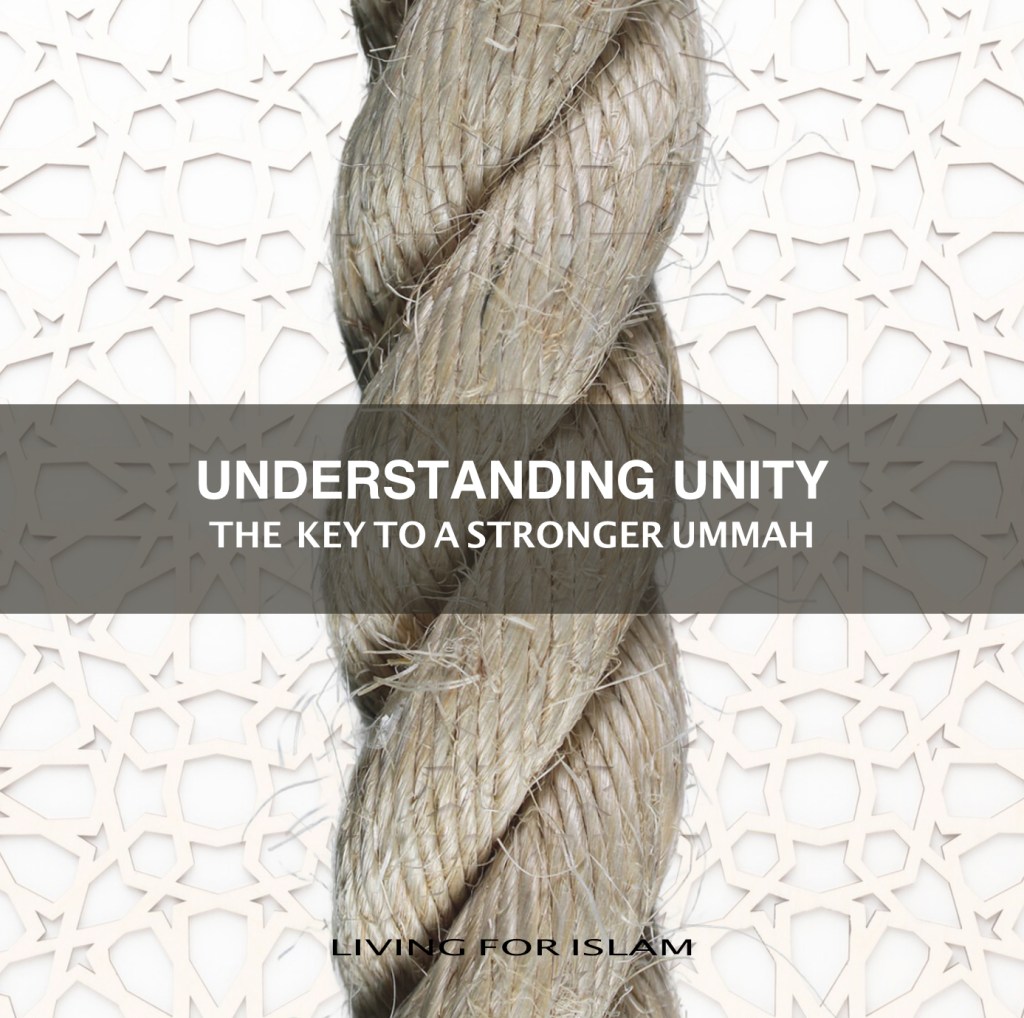
وَٱعْتَصِمُوا۟ بِحَبْلِ ٱللَّهِ جَمِيعًۭا وَلَا تَفَرَّقُوا۟
And hold firmly together to the rope of Allah and do not be divided. (ale Imran 103)
Islam was revealed to solve human problems. It was not intended for angels. The values and rules given by Allah to the Muslims of Madinah to address their issues then can also help us overcome our disunity today.
 Living For Islam
2 thoughts on “Understanding Unity: The Key to a Stronger Ummah”