

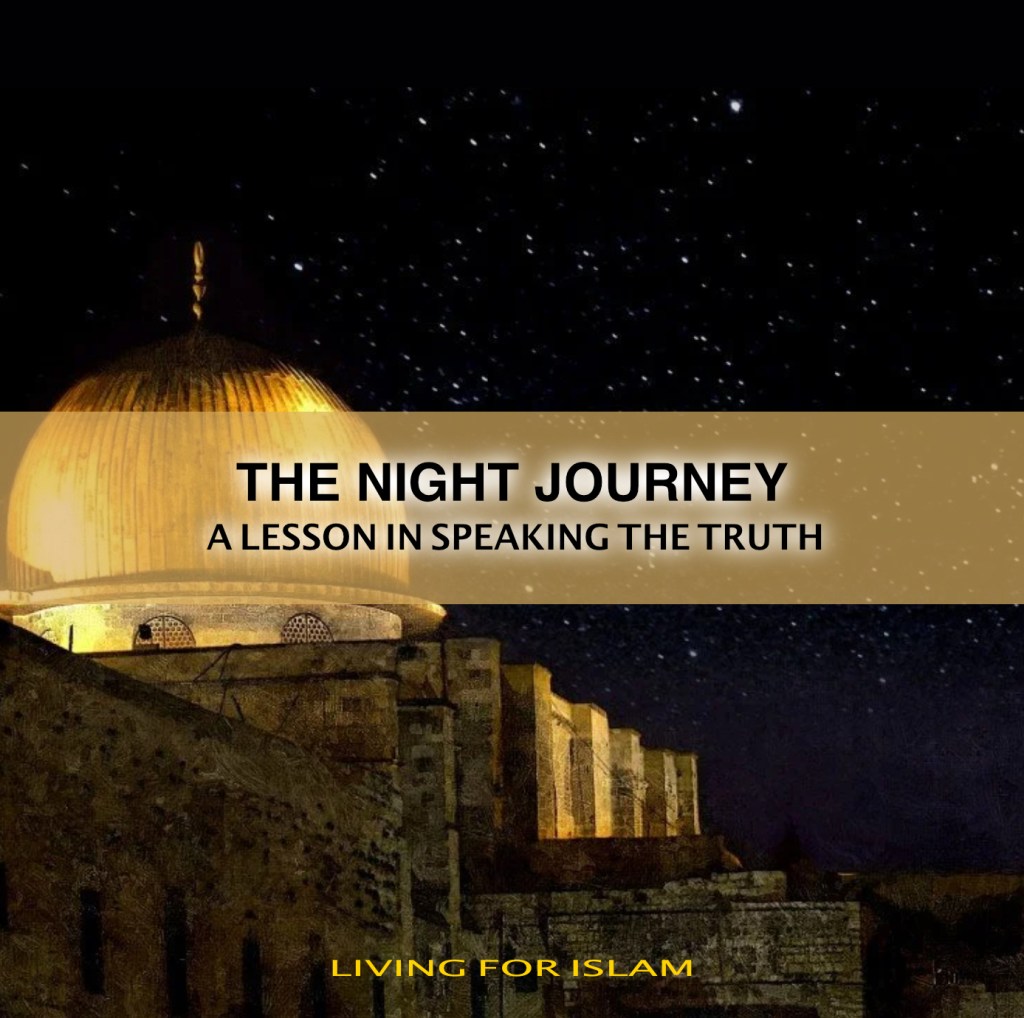
A MIRACULOUS NIGHT journey. With Jibril (as), the Prophet ﷺ travelled on a winged creature whose stride took it as far as the eye could see. They paused at various places before arriving at the Holy Land and masjid al Aqsa. He led all the prophets in prayer, affirming his foremost position amongst the prophets and that he was the last of them.
From there he ﷺ went up to the heavens with Jibril (as), meeting angels and prophets. He ﷺ saw the beautiful sights of Jannah, the rewards for its people, and the punishments for those in Jahannam.
And he ﷺ was given something that made everything else seem insignificant.
He met Allah ﷻ.
That gave him comfort and reassurance after the difficulties he faced with the deaths of his wife Khadijah (ra) and uncle Abu Talib, as well as the terrible treatment of the people of Taif.
He ﷺ had received the command to pray 5 times a day.
And he had then returned back to his home in Makkah, all in one night.
The next morning, he ﷺ told the Quraysh about his journey. He hoped that it would draw them close to Allah.
They laughed at him ﷺ and his outrageous tale. How is that possible? A journey that would take weeks by camel accomplished in a single night. They called him a magician. They called him a soothsayer.
They questioned him about the prophets that he had met. He described Isa (as), Musa (as) and Ibrahim (as).
They asked him about Jerusalem, a place they knew well. The Prophet ﷺ had never been there before and as he had travelled at night, his memory was limited. However, Jibril (as) showed him a picture of Jerusalem, and he could describe it to them clearly, leaving no doubt.
He told them about caravans he had passed and even when the Quraysh confirmed it, they still would not believe it.
The night journey even affected some of his companions. It was too much for them to believe, and they left Islam.
But for some, this news only made them stand out more. One of them was Abu Bakr (ra). Here is what he said to the Quraysh when they asked about his friend’s unusual experience.
‘And did he say that?’ Abu Bakr (ra) asked.
They said: ‘Yes.’
“If he said that, then he has spoken the truth,’ Abu Bakr confirmed.
‘Do you really believe him when he says that he went during the night to Jerusalem and came back before the morning?’
‘Yes, I indeed believe him concerned that which is more amazing than that. I believe him about news from the heavens, which comes in the morning or at the end of the day.’
This incident earned Abu Bakr (ra) his title as-Siddiq – the verifier of the truth.
Here is a key lesson for us today.
The Messenger ﷺ told the Quraysh about the incident. That in itself is remarkable. The Quraysh had already labelled him as mad and this admission was surely confirmation of their claims against him.
Nevertheless, the Prophet ﷺ and Abu Bakr (ra) stood up for the truth, even when it was not accepted by society. They spoke out in a world that rejected and mocked the truth, but they did so without fear of being criticized or harmed.
We too live in a hostile environment where speaking the truth is difficult. There’s a lot of doubt and confusion about our Deen. We often face tough questions about Islam that aim to undermine our beliefs and promote liberal values.
Abu Bakr’s (ra) response serves as a blueprint of how to respond in such circumstances.
Our starting point is having the absolute conviction that Islam is the truth. That does not mean that we have to know everything about our Deen. Rather we appreciate that Islam is perfect and complete and if there is any deficiency, it is a deficiency in our understanding and not a deficiency in Islam. If there is any confusion and doubt, it is confusion and doubt in our minds alone.
From that strong foundation, if we know something is from Allah ﷻ and His Messenger ﷺ based on clear evidence, we accept it without hesitation. Where we have knowledge and confidence, we speak truthfully and with wisdom. Where we are unsure, we seek knowledge until we are confident and can speak the truth.
يَـٰٓأَيُّهَا ٱلَّذِينَ ءَامَنُوا۟ ٱتَّقُوا۟ ٱللَّهَ وَقُولُوا۟ قَوْلًۭا سَدِيدًۭا
O believers! Be mindful of Allah, and say what is right. (al-Ahzab 70)
 Living For Islam